

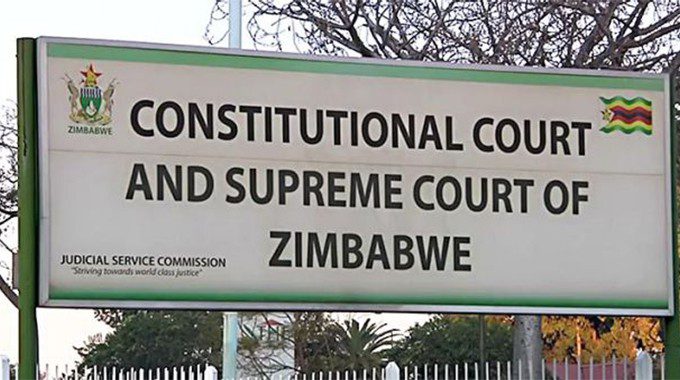
A Zimbabwean citizen, Youngerson Matete, has filed a direct application in the Constitutional Court seeking to nullify the recently enacted Private Voluntary Organisations (PVO) Amendment Act, No. 1 of 2025.
The PVO Amendment Act itself is highly contentious, introducing sweeping new regulations, registration requirements, civil and criminal penalties for non-governmental and charitable organisations, citing compliance with international Financial Action Task Force recommendations.
The application, filed on 24 December 2025 and citing Parliament, the Minister of Public Service, Labour and Social Welfare (Edgar Moyo), the President (Emmerson Mnangagwa) and the Attorney General (Virginia Mabiza), as respondents, alleges that the law was birthed through a “legally irregular process” that “flouted the Constitution and the Standing Orders.”
“The legislative process that culminated in the promulgation of the Private Voluntary Organisations Amendment Act No. 1 of 2025 violated Sections 131 (2) and (4), of the Constitution and Section 133 (1) and 138 (1) of the Parliament of Zimbabwe (The Senate) Standing Rules and Orders and in that regard, Parliament failed to fulfil its constitutional obligations,” Matete said in his founding affidavit.
“In allowing the Private Voluntary Organisations Amendment Bill to sail through its processes in light of the violations referred to in paragraph 1 above, Parliament failed to fulfill its obligations in terms of section 119 (1) and (2) of the Constitution of Zimbabwe
“In assenting to the Private Voluntary Organisations Amendment Bill, which had not been passed in accordance with the constitution as read with the Standing orders, the President failed to fulfill his constitutional obligations in terms of section 90 (1) of the Constitution obliging him to ensure the constitution and all other laws are faithfully observed.”
Matete said the enactment of the PVO act, which came into effect on 1 April 2025 falls foul of that basic constitutional requirement.
“Being a concerned citizen, I thus have a right to see to it that the laws that bind me and other citizens are promulgated through processes not marred with irregularity,” he said in his founding affidavit.
“Consequently I am entitled as such to being governed by laws that are properly promulgated in terms of the applicable procedural legislative processes and to challenge laws that fall below that standard. As such I have a direct and substantial interest in the matter.”
At the core of Matete’s challenge is that the PVO Bill debated and passed by the National Assembly was fundamentally different from the one later sent to the Senate, bypassing crucial stages of scrutiny and violating mandatory procedures.
“It is inexplicable that a Bill approved during debate by the National Assembly would reach the Senate, in the same building, with missing clauses,” states Matete in his founding affidavit.
“Clearly, it is apparent that the National Assembly and the Senate in the first and second reading debated and passed two fundamentally different Bills.”
The application hinges on detailed procedural allegations. It notes that when the Bill was transmitted to the Senate in October 2024, key sections, including the Long Title and Clauses 2, 3, 4, 5, 7, 8, 9, 10, 14 and 25 were absent. These omissions were only addressed months later in February 2025, when the Minister of Justice, Ziyambi Ziyambi, initiated an unusual “re-committal” process during the Senate’s third reading.
“There is no such process provided for in the constitution or Standing Orders whereby a Bill is re-committed to a House of Parliament,” argues the applicant.
“Such procedure is alien and has no basis at law.”
The filing includes damning evidence from the parliamentary record (Annexure A), a Hansard extract where Minister Ziyambi concedes the omissions, stating: “We have clauses that were omitted when the Bill was transmitted from the National Assembly to the Senate.”
The applicant argues this fatally flawed process means the Bill that eventually received Presidential assent never properly underwent the constitutionally required first and second readings in the Senate.
“The Bill that in fact passed the third reading in Senate and was presented to the President for assent never went through the first and second readings. It only went through the third reading,” the affidavit reads.
Furthermore, the application accuses Parliament of failing its constitutional duty to “protect the Constitution and promote democratic governance,” and charges that the President violated his oath of office by assenting to a Bill not passed in accordance with the law.
“Nothing legally valid can be born out of a legally irregular process. It is a nullity and cannot stand,” the application concludes, seeking an order for the entire act to be “struck down and declared invalid.”
The respondents have 21 days to file notices of opposition.
Support CITE’s fearless, independent journalism. Your donation helps us amplify community voices, fight misinformation, and hold power to account. Help keep the truth alive. Donate today
Leave a comment