

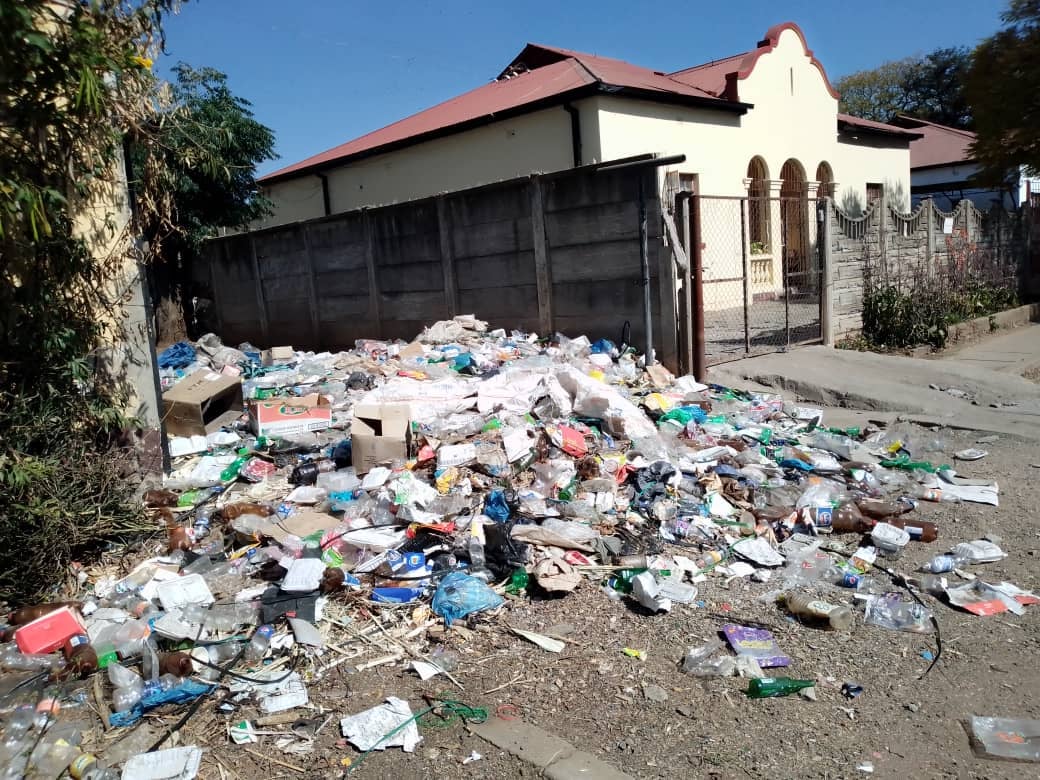
Authorities in Bulawayo have warned of a looming public health crisis as a combination of rampant littering, open defecation, and “toothless” law enforcement leaves Zimbabwe’s second city vulnerable to deadly disease outbreaks.
During a heated full council meeting held this month, local representatives described the city’s sanitation crisis as a “spreading cancer,” with fears mounting that the current rainy season could trigger a surge in cholera and other waterborne illnesses.
The alarm was first raised by Ward 25 councillor Aleck Ndlovu, who told the chamber that despite sustained awareness and clean-up campaigns, littering levels in the central business district (CBD) and marketplaces continue to rise.
“The levels of littering appear to be rising… despite all these awareness campaigns, education and clean-up campaigns, which poses a risk,” Cllr Ndlovu said.
He added that councillors had recently viewed films and images of massive garbage piles across the city, leading to calls for a total overhaul of municipal penalties.
“The biggest problem we have is that we are too lenient in terms of our penalties. We need to relook at our penalties so that the residents become afraid.”
The debate took a sharper turn when Ward 3 councillor Mxolisi Mahlangu pointed to the breakdown of basic sanitation and the rise of open defecation. He specifically challenged government policy, arguing that the protection of informal vendors was being prioritised over public safety.
“I do not understand how we are still being told that we must provide decent places for vending when people are practising open defecation and they are allowed to do this everywhere in the city,”Cllr Mahlangu stated.
Cllr Mahlangu warned that the arrival of the rains had turned the city into a biological hazard zone.
“It is the rainy season now, our drainage systems are poor, water is flooding and moving with faeces everywhere. Surely, are we not in danger of cholera? Are we not in danger of all other related diseases related to faeces when consumed? Human faeces kill,” he said.
He called for the urgent involvement of the Joint Operations Command (JOC), Zimbabwe’s supreme state security organ, to assist in cleaning the streets and restoring order.
Bulawayo Mayor David Coltart echoed these concerns, admitting that the city’s cleansing department is currently “overwhelmed” by a crisis that has moved beyond traditional problem areas.
“We are dealing with a harsh reality and it is spreading. It is going beyond Fourth Avenue. It is like a cancer,” the Mayor told the meeting.
He highlighted a critical lack of enforcement power, describing the municipal police as “toothless” because they currently lack the legal authority to effectively enforce city by-laws.
Mayor Coltart also took aim at large-scale polluters, particularly construction firms.
“These construction companies who are dumping waste on Old Gwanda Road need to be fined heavily, because when they only get fined US$30, it is actually less than the petrol price of taking that rubbish to our official sites,” he said.
He proposed that fines for large-scale dumping be increased to “hundreds of dollars” to act as a genuine deterrent.
While the council seeks a crackdown, the debate has highlighted a complex socio-economic struggle. The Mayor acknowledged that many vendors are “innocent people who have been thrust into the informal sector because they have lost their jobs,” emphasizing the need for “alternative, viable, attractive venues” rather than just law enforcement.
However, the proposal to involve security forces has met with caution from informal sector representatives.
Samuel Wadzai, executive director of the Vendors Initiative for Social and Economic Transformation (VISET), said that while they support order, it must be done within the law.
“We do not expect them to use violence… We encourage them to use alternatives that encourage engagement and education that do not go against human rights instead of involving the JOC order,” Wadzai said.
Michael Ndiweni, head of the Bulawayo Vendors and Traders Association (BVTA), added that the city must “exhaust all the options for us to dialogue” before turning to security-led enforcement.
Support CITE’s fearless, independent journalism. Your donation helps us amplify community voices, fight misinformation, and hold power to account. Help keep the truth alive. Donate today