

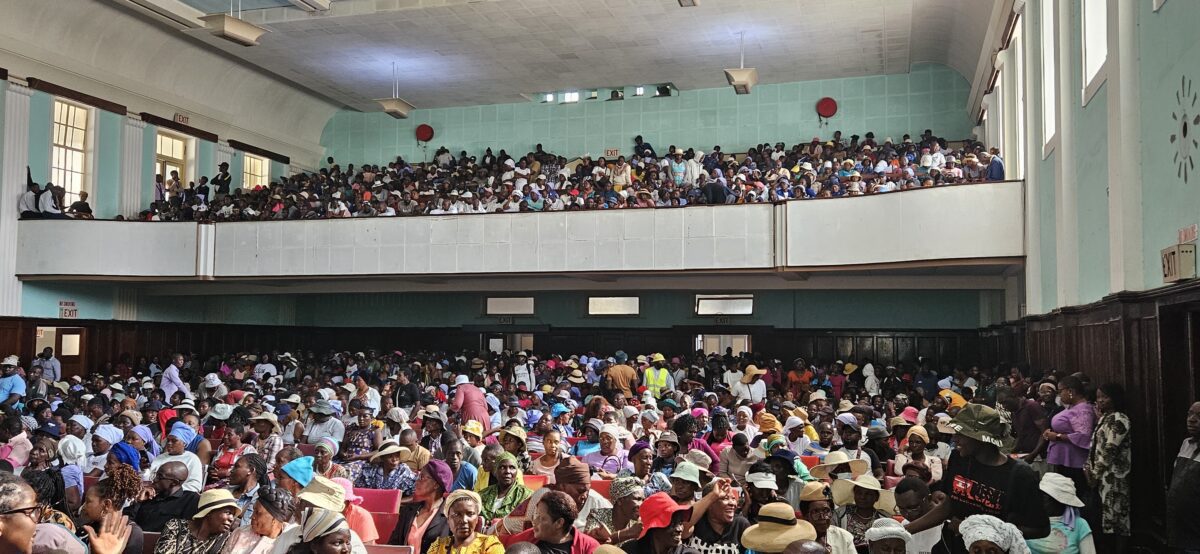
The Parliamentary public hearing on the Constitutional Amendment Bill No. 3 held at the Large City Hall in Bulawayo on Monday drew thousands of people, however, what was meant to be a platform for citizen input has sparked controversy, amid allegations that the process was exclusionary, involved organised bussing and may have been orchestrated.
The hearing, conducted by Parliament’s Portfolio Committee on Justice, Legal and Parliamentary Affairs, was intended to gather public input on proposed constitutional changes.
Instead, the manner of the hearings raised serious questions about the legitimacy of the views submitted and whether the process truly reflected the will of the people.
By mid-morning, the venue had reached full capacity, leaving hundreds, if not thousands, stranded outside without access.
For many in Bulawayo, Monday’s events have already cast doubt on the credibility of the exercise.
Those locked out included both prominent citizens and ordinary residents who had hoped to participate in shaping what is one of the most consequential constitutional proposals in Zimbabwe’s post-2013 era.
When the media arrived, Zanu PF Bulawayo provincial officials appeared to be directing proceedings inside the venue, raising concerns about political influence over what should be a parliamentary process.
The hearing started at 10am and ended at 11:28am, despite indications that each session would last at least two hours and assurances that members of the public would be given adequate time to air their views.
Inside the hall, proceedings were chaired by Elizabeth Masuku, who opened the session by outlining the constitutional obligation for public participation.
“Section 141 requires Parliament to facilitate public involvement in its legislative processes… and Section 328(4) compels Parliament to invite members of the public to express their views through written submissions and hearings,” she said.
Masuku urged participants to identify specific clauses in the Bill when making submissions, noting that the proposed law contains 22 clauses.
However, as the hearing unfolded, concerns began to emerge about the nature of that participation.
Observers noted many attendees appeared to have been transported to the venue in an organised manner, with allegations that ruling Zanu PF supporters were bused in, some reportedly from areas such as Umguza.
After the hearing, groups of attendees were seen rushing back onto buses, reinforcing perceptions of coordinated mobilisation.
Outside the venue, in the City Hall courtyard, some individuals were reportedly seen coaching participants.
During the hearing, others appeared to be reading submissions directly from their mobile phones, in what some described as scripted interventions.
Some attendees were reportedly informal traders who had been instructed to leave their stalls at the Fifth Avenue market to attend the hearing.
At least two speakers introduced themselves as vendors and expressed support for President Emmerson Mnangagwa’s efforts to improve their livelihoods.
It was also observed that many participants used similar phrasing, often beginning their contributions with: “I rise today in full support of the Constitutional Amendment Bill No. 3,” before citing specific clauses they supported.
These developments have fuelled fears that the hearing may not have been a genuine consultation, but rather a managed process designed to project public support.
In total, 37 speakers were given the opportunity to present their views. Of these, 28 spoke in support of the Bill, while nine opposed it.
Notably, those in favour largely focused on specific provisions they supported, often citing clauses in detail.
In contrast, those against the Bill framed their objections more broadly, arguing that the proposed changes undermine the spirit and principles of Zimbabwe’s 2013 Constitution.
The first speaker, Ernest Gere from Cowdray Park, supported Clause 19, which removes the requirement for the President to appoint the Prosecutor-General on the advice of the Judicial Service Commission.
“I support Clause 19 as it allows the president to make efficient appointments,” she said.
However, the second speaker, Sehliwe Tshuma from Entumbane, rejected the Bill outright.
“The Constitution belongs to the people. It was adopted through a referendum and represents the will of the people. Any changes must also go through a referendum, not a Bill,” she said.
Tshuma also opposed the proposed disbandment of the Zimbabwe Gender Commission.
“We will not allow the Gender Commission to be reduced to a mere desk under the Zimbabwe Human Rights Commission,” she said.
Other opponents echoed similar concerns. Butholezwe Ncube warned that the Bill would strip citizens of their right to directly elect the President.
“It takes away one’s right to vote for the President, something people look forward to and gives that power to MPs and Senators. It takes away our democratic space,” Ncube said.
Tsepang Nare, representing persons with disabilities, questioned the accountability mechanisms under the proposed system.
“The Bill will result in a President with more powers, yet MPs will have no power to hold him accountable. Can they pull a vote of no confidence?” Nare asked.
Nare also opposed granting traditional leaders political rights, arguing it could lead to discrimination in access to government services.
A youth participant, Stanford Dube, criticised proposed changes to presidential term limits.
“Youths are unemployed, disenfranchised and economically excluded. Clause 3, which seeks to substitute the current five-year term with a seven-year term, removes our mandate. We want to elect our own representatives,” he said.
Those in favour of the Bill defended it as a means to enhance governance efficiency, stability and would cut electoral costs .
Several speakers supported extending the presidential term from five to seven years, arguing that it would allow more time for developmental projects to be completed.
Others backed Clause 2, which proposes a parliamentary system for electing the President, saying it would streamline leadership selection.
Supporters also endorsed provisions to expand the Senate through presidential appointments, arguing it would “bring in broader technical expertise” and strengthen oversight.
Clauses restructuring electoral functions, such as transferring voter registration responsibilities to the Registrar-General and creating a Zimbabwe Electoral Delimitation Commission, were also widely supported among pro-Bill speakers.
Additionally, proposals to subsume the Zimbabwe Gender Commission under the Zimbabwe Human Rights Commission were framed as a move to consolidate human rights protection.
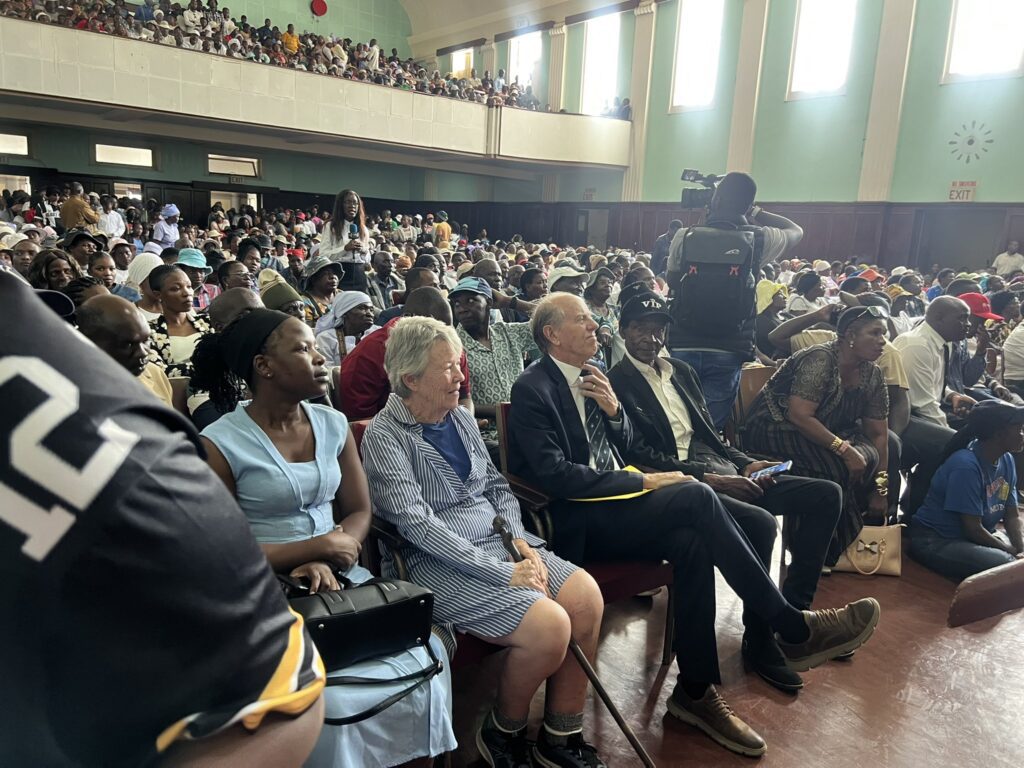
Among those denied an opportunity to speak was Bulawayo Mayor David Coltart, who attended the hearing in his personal capacity.
“I was there as a citizen, a lawyer of 43 years standing, an initial co-chair of COPAC and a member of the deadlock-breaking committee of COPAC. I was not there in my capacity as Mayor,” Coltart said.
Colart repeatedly raised his hand and at one point stood up to attract the chairperson’s attention, but was ignored and even heckled by suspected Zanu PF supporters who shouted that he must “focus on repairing potholes and provide water.”
“When the Chair called for contributions I put my hand up and continued to do so every time the Chair called for contributions. The Chair studiously ignored me… Eventually I stood up with my arm raised… I caught the eye of the Chair on several occasions. She just ignored me,” he said.
Coltart attended the hearing alongside 83-year-old liberation struggle figure Judith Todd, who was also not given an opportunity to speak.
“At about 11:30am the meeting was brought to a sudden and abrupt end. Neither Judith Todd nor I was given an opportunity to speak,” he said.
Colart added that hundreds of others were similarly denied a chance to contribute.
Despite the structured presentations, critics argue the process itself undermined the legitimacy of the outcomes.
Coltart described the hearing as “inadequate, unconstitutional and indeed farcical,” noting that a city of over 700 000 people had been allocated only two meetings, of which another was in Nketa Hall in the afternoon.
“In reality, the time allocated to speak was just over an hour. We can do so much better as a nation,” he said.
In contrast, the parliamentary committee chairperson defended the hearing, describing it as orderly and successful.
“We are very happy about what happened. People were participating very well, no noise and with respect. It was overwhelming and we are happy about that. Some were supporting, some were not supporting, everything was well done. No noise, nothing,” Masuku said.
When questioned about the duration of the session, Masuku insisted it had run for the full allocated time.
“We allocate at least two hours. There was no remaining 30 minutes. It was two hours exactly because I was on a timer,” she claimed.
The Constitutional Amendment Bill No. 3 was published in the Government Gazette on 16 February 2026.
Parliament subsequently invited the public to submit written submissions by 25 February 2026. Two weeks ago, it further advertised that public hearings would be held from 30 March to 2 April 2026, a timeframe ‘many’ Zimbabweans have criticised as too short for such significant constitutional changes.
Support CITE’s fearless, independent journalism. Your donation helps us amplify community voices, fight misinformation, and hold power to account. Help keep the truth alive. Donate today