


By Ajibola Amzat
Reading from a prepared text at a press conference held in Abuja on February 10, Andrey Podyelyshev, the Russian ambassador to Nigeria, denied that the Russian government is recruiting Nigerians to fight in its war against Ukraine.
“There is no government-supported program to recruit Nigerians to fight in Ukraine,” he told journalists at the press briefing.
The Guardian conducted an investigation into the claim and discovered that the ambassador had manipulated the facts.
Victim testimonies, diplomatic reports, and government warnings show that the Russian Federation has indeed shown a consistent recruitment pattern in its army. The Russians secretly hired several Africans, including Nigerians, into the national army to fight in Ukraine.
Take Adamu Abubakar’s story as a case study. A former formal officer with the Nigerian Navy and native of Kano, Abubakar applied for a 90-day tourist visa, which was to allow him to stay between October 20, 2025, and January 17, 2026.
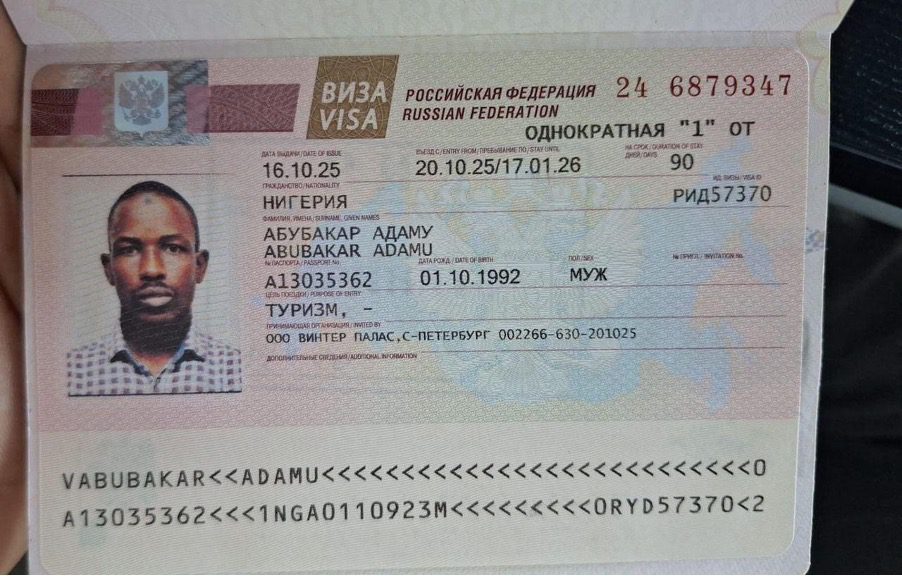
According to his lawyer, Abu Suleiman, the travel agent who facilitated his journey, deceived him into believing he was getting a private civilian security job in Russia that would pay a monthly salary of $2 000.
Upon reaching his destination, Abubakar was forced to sign a contract written in Russian and was conscripted into the Russian army. Afterwards, he and his travel mates were taken to the military camp, where they underwent three weeks of training before they were sent to the front line of the battle. When he realised his employer’s ploy to use them as cannon fodder in a war they knew nothing about, Abubakar declined, knowing that he had been misled into a dangerous situation that jeopardised his life and safety.

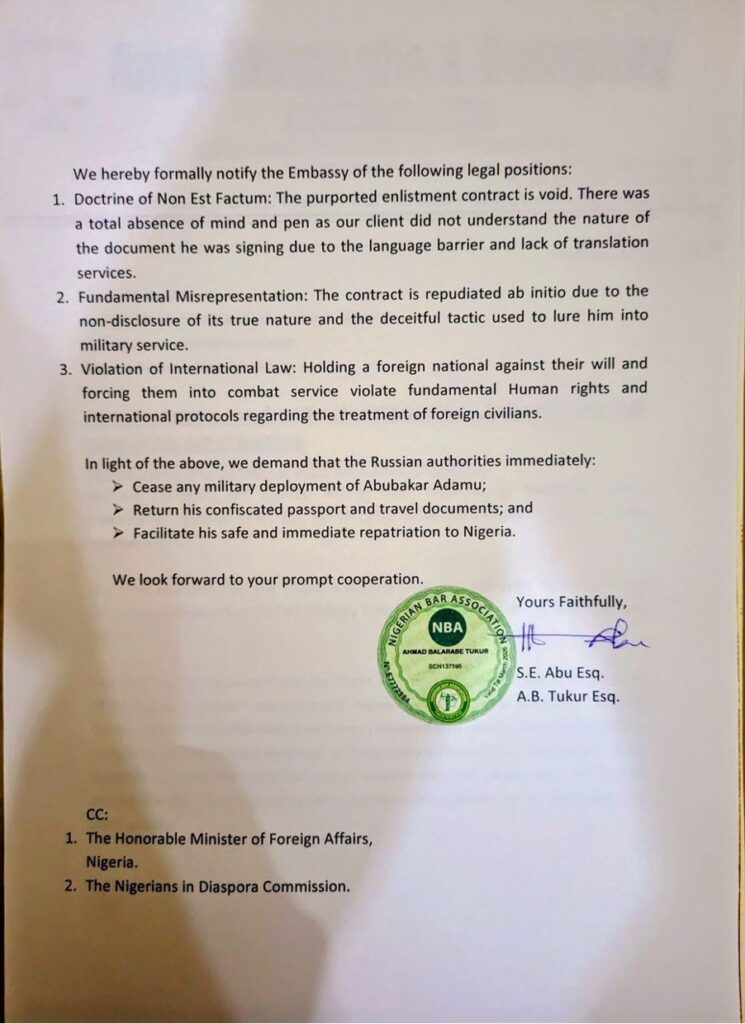
Abubakar’s wife, Hadiza Abubakar, narrated her husband’s ordeal to The Guardian. The travel agent, Emiola Muhammad, who helped him from Nigeria, promised he would get a civilian security guard job in Russia that would pay well.
“I even encouraged him to go, knowing that he needed a better-paying job after he resigned from the Nigerian navy,” Hadiza said. Abubakar is the breadwinner of his extended family, comprising his two wives, two daughters, sisters, and a blind father. His mother died many years ago.
Therefore, in November 2025, Abubakar and three others travelled to Russia. His traveling mates were Akinlawon Tunde Quyuum, Abugu Stanley Onyeka, and Adam Anas.
On the first day of his arrival in Moscow, he regretted his decision because he was told they were converting their job to military service, the wife said.
She said her husband was the only Nigerian draftee who refused to leave the training camp and go to the battlefront, and the rest who did have died.
Another family of a victim, Ifeoluwa, identified as MiniNest by Pearl on Instagram, accused Felicia Traveling Agency of recruiting her cousin into the Russian army under the guise of helping him obtain work visas. Ifeoluwa claims that her cousin, who enlisted in the Russian army in November 2025, has now passed away.
The Guardian called Ms. Felicia Samuel, owner of the Felicia Travel Agency, to understand how the agency processes Russian visas for applicants, but her phone line was not connecting at the time of this report. She also did not respond to messages sent to her on WhatsApp. Her Instagram page is locked, so visitors cannot send a direct message.
CNN has interviewed other African recruits who signed military service contracts in Russian without the assistance of lawyers or translation. Some had their passports confiscated, effectively making it impossible to flee, CNN reported.
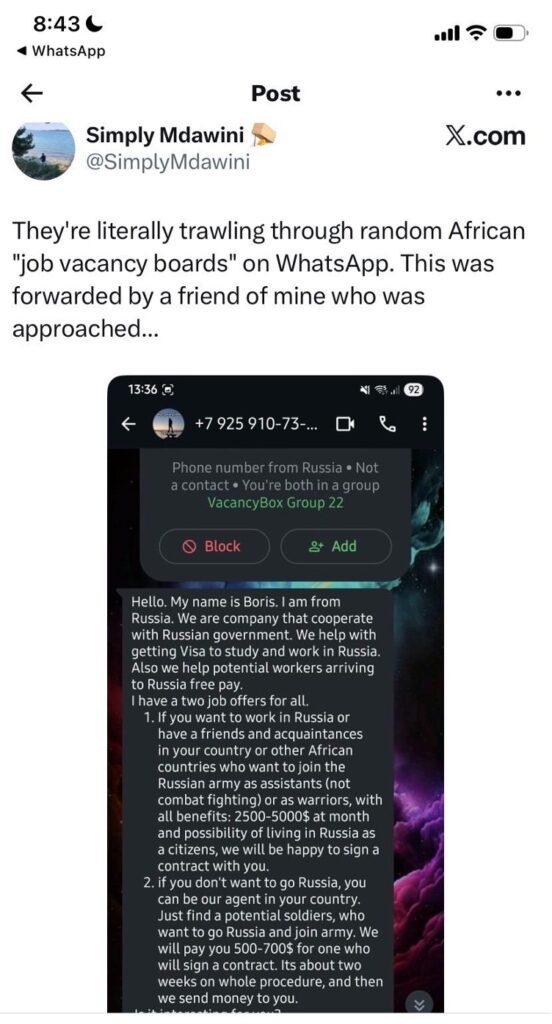
According to the French Institute of International Relations, at least 3 000 Africans are among the foreign fighters serving in the Russian army. The number might increase as recruitment agents continue to advertise job opportunities in Russia through multiple social media platforms. A recruiter named, Boris, is reportedly trolling people on Telegram and WhatsApp and persuading them to apply for government jobs or recommend interested applicants.
Multiple African governments have confirmed the recruitment or deaths of their citizens during the Russian-Ukrainian war.
In a statement, Ukraine said its military intelligence operatives confirmed the death of two Nigerians fighting on the Russian side. They are Hamzat Kazeen Kolawole, 42, and Mbah Stephen Udoka, 38.
The deceased reportedly served in the 423rd Guards Motor Rifle Regiment of the armed forces of the Russian Federation, according to an AP report.
The Nigerian government has not confirmed the death yet.

Notwithstanding, the Nigeria Ministry of Foreign Affairs’ spokesperson, Kimiebi Imomotimi Ebien, said the Nigerian missions in Moscow and Kyiv have received reports that both Russia and Ukraine have been using private recruitment agencies to bring Nigerians and other Africans to Russia and Ukraine for the purpose of fighting in their war. He said the investigation is underway to identify the local recruiting agencies responsible for the illicit recruitment.

A new Kenyan intelligence report states that 1,000 Kenyans were recruited to fight for Russia in Ukraine after being misled by false promises of jobs and then sent to the front lines. Parliamentary leader Kimani Ichung’wah presented the report to parliament on February 18. He accused Russian embassy officials of collaborating with work recruitment agencies to deceive Kenyans into thinking they would receive skilled jobs in Russia. He said the Russian embassy officials issued them tourist visas.
The Ghanaian government has also expressed concern over the recruitment of citizens to fight for Russia, often with promises of jobs or training abroad. Foreign Affairs Minister Samuel Okudzeto Ablakwa reported that since 2022, Russia has drawn 272 Ghanaians into the war, resulting in at least 55 Ghanaians’ deaths.
Diplomatic and intelligence reports indeed indicate the practice is widespread across Africa.
European Union (AU) ambassador to Nigeria and ECOWAS, Gautier Mignot, confirmed that Russia has been recruiting Nigerians and other Africans in its war against Ukraine for quite some time.
He said, “It’s cruel to send people who have nothing to do with the war to die.”
The Guardian reached out to the Russian embassy again to present new evidence of Nigerian recruitment into the Russian army. The spokesperson for the Russian embassy in Nigeria, Daria, responded that the embassy has commented on the topic several times and referred the reporter to review the previous statement.
The statement reads in part: “We reaffirm that the Russian Federation operates no official or state-run programme aimed at recruiting citizens of Nigeria. The Embassy possesses no information about the existence of any fraudulent schemes or criminal networks that lure Nigerian nationals into combat roles.”
It insisted that “The Russian Embassy in Abuja did not issue visas to the individuals named Balogun Adisa Ridwan and Abubakar Adamu.”
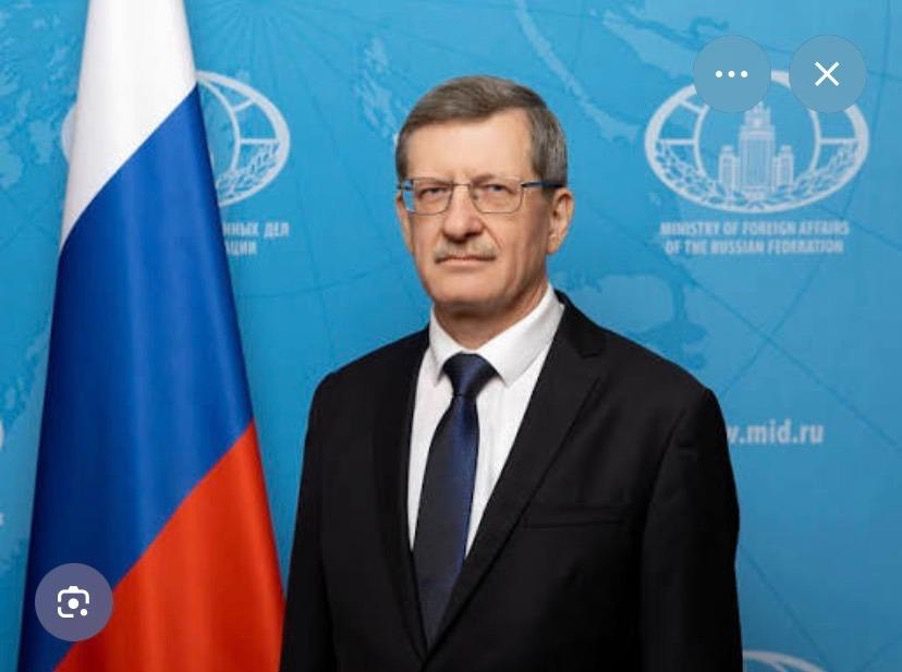
However, Abubakar’s lawyer was not convinced by the ambassador’s words.
“How did Abubakar obtain the visa? How did he end up in the Russian uniform? Who pays his salary as a Russian soldier?” Barrister Suleiman asked.
Combat uniforms similar to the Russians’
In August 2025, Russian President Vladimir Putin signed a new decree that all clothing and gear for the Russian Armed Forces must be produced by Russian companies with manufacturing facilities within the country. The decree requires Russian soldiers to wear only military gear made in Russia or authorized by the government.
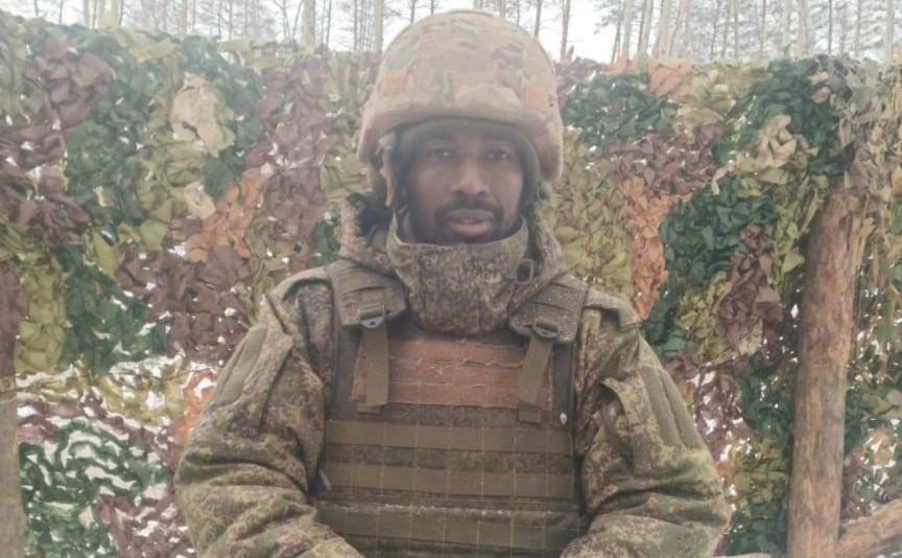
Using ChatGPT, WikiTimes carried out a forensic check of the uniform worn by Africans identified as fighting in Russia and found that it was similar to those authorized for Russian soldiers.
The uniform indeed contains several elements consistent with gear used by Russian soldiers, particularly the digital camouflage pattern, helmet style, and MOLLE body armor.
The uniform appears to use a green-brown pixelated camouflage pattern that resembles EMR “Digital Flora,” the standard camouflage used by the Russian military. The pattern is common in Russian field jackets and cold-weather gear.The helmet has a rounded composite design with a camouflage cover that resembles the 6B47 ballistic helmet, commonly issued to Russian soldiers.In many of the photographs seen,the soldiers appear to be wearing a plate carrier/body armor vest with MOLLE webbing, which is a system of modular lightweight load-carrying equipment that allows for the attachment of various pouches and accessories.Russian troops frequently use body armor such as the 6B45 vest, which has similar horizontal webbing rows for attaching equipment.
The high insulated neck guard or balaclava-style covering is typical of Russian cold-weather combat gear. Russian troops operating in Ukraine often wear winter VKBO/VKPO layered uniforms.
The helmet cover, jacket, and combat gear share similar camouflage tones, which is consistent with standardized military kits rather than mixed civilian gear.In addition, the background of the photo taken by Abubakar shows military camouflage netting, commonly used at field positions or training grounds.
Meanwhile, reports indicate that some African countries are already rescuing their citizens from Russia, with South Africa organizing evacuation efforts for its nationals amidst the ongoing conflict. Last month South Africa secured the return of 11 men lured into the Russia-Ukraine war; four had returned earlier.
Three people, including Duduzile Zuma-Sambudla, the daughter of the former South African president Jacob Zuma, are being investigated in connection with the 17 men recruited into the Russian army.
The Guardian interviewed the Nigerians in the Diaspora Commission (NiDCOM) about the effort Nigeria is making to secure the return of Nigerians lured to fight in Russia. NiDCOM spokesperson Abdul Rahman Balogun declined to comment. He asked the reporter to speak to the Ministry of Foreign Affairs instead.
Meanwhile, a source within the Commission told The Guardian that the Nigerian government does not have resources to keep rescuing people who are stranded abroad, which raises concerns about the government’s ability to assist citizens in distress and the potential consequences for those in vulnerable situations, such as increased risks of exploitation or worsening mental health issues for individuals like Hadiza’s husband.
“NiDCOM does not have a huge budget to rescue every Nigerian in distress abroad. So people need to be careful about their traveling decision,” the NiDCOM official said.
MoF Spokesperson Ebien said Nigeria is investigating the matter and compiling the list of Nigerians in Russia. He asked the family to report to the ministry so the federal government can engage Russia.
He also warned Nigerian citizens of patronizing traveling agencies that promote jobs in war zones, as these opportunities can expose them to dangerous situations and legal complications in foreign countries.
“If you have any offers going to Eastern Europe for now, either for scholarship or job offers, double-check with the ministry of foreign affairs so that we can cross-check with our embassy in both Ukraine and Russia to avoid being lured outside the country and finding yourself in a difficult situation,” Ebien said.
However, Abubakar’s lawyer said he had contacted the Ministry of Foreign Affairs as far back as January but had yet to receive a response.
As the bureaucratic process drags on, Abubakar’s wife, Hadiza, says the uncertainty has taken a heavy emotional toll on the family. She has only one appeal to both the Nigerian and Russian governments: “Please help bring my husband home. He is terribly depressed and needs support during this difficult time.”
Ajibola Amzat is a Nigerian investigative journalist. He is currently the African editor for the Centre for Collaborative Investigative Journalism. He writes for The Guardian (Nigeria) and WikkiTimes.