

Diaspora remittances have become an increasingly important lifeline for Zimbabwean households, with money sent home by citizens working abroad more than doubling over the past six years as families grapple with rising living costs and economic hardships.
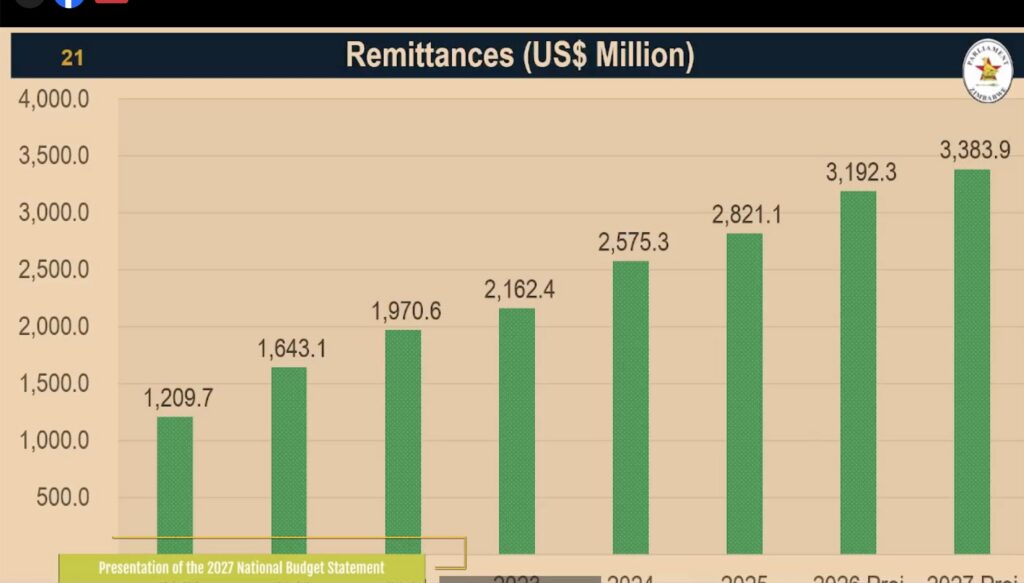
Figures presented in the 2027 National Budget Statement show that remittances increased from US$1.21 billion in 2020 to US$3.19 billion in 2026, with inflows projected to reach US$3.38 billion next year.
The sustained growth highlights the growing reliance on Zimbabweans living abroad to support relatives back home, with funds helping households meet basic needs, pay medical expenses, support children’s education and invest in homes and other assets.
Presenting the 2027 National Budget on Thursday, Finance Minister Mthuli Ncube said diaspora remittances had grown significantly, reflecting their increasing contribution to the economy.
On this topic
“Diaspora remittance inflows grew significantly by 39.9% to US$2.5 billion during the first nine months of 2026 are projected to surpass US$3.3 billion and US$3.4 billion in 2026 and 2027 respectively from US$1.2 billion in 2020,” Ncube said.
The figures show a consistent upward trajectory, with remittances rising from US$1.64 billion in 2021 to US$1.97 billion in 2022 and US$2.16 billion in 2023.
Inflows increased further to US$2.58 billion in 2024 and US$2.82 billion in 2025 before reaching an estimated US$3.19 billion this year.
The projected US$3.38 billion for 2027 represents an increase of approximately 180 percent from the 2020 figure.
The growing contribution comes as households continue to face economic pressures, making financial assistance from relatives abroad increasingly important for survival.
Leader of the African Diaspora Global Network, a migrant-rights organisation based in South Africa, Dr Vusumuzi Sibanda, said the figures demonstrated the sacrifices Zimbabweans in the diaspora were making to support their families.
“Behind the billions of dollars entering the country are migrants working long hours, often juggling multiple jobs, to keep their families back home afloat. We know most of the households have at least one sibling or relative in the diaspora who have to send help back home because the Zimbabwean economy is terrible, ” he told CITE.
He said while remittances were helping families cope with difficult economic conditions, the growing dependence on money from abroad also exposed the challenges facing the local economy.
“It’s sad that Zimbabweans now have to survive on money coming from outside. This also shows how hard it is for migrants who have to work hard, some having several odd jobs to make ends meet,” he said.
For many households, the support goes beyond occasional financial assistance, with relatives abroad regularly sending money and groceries to cover daily expenses and provide for family members who cannot support themselves.
A Nketa resident, Sinanzeni Ndlovu, said money sent by her siblings abroad has been helping her pay for medication for their elderly parents’ food and other essential expenses.
“Without such support, one wonders what we would be doing since our parents are old and always need pills for this and that ailment,” she said.
Another resident in QueensPark West, Victoria Mthupha, said diaspora support has helped their family renovate their home and also expressed gratitude to sacrifices made by relatives working abroad.
“This is in addition to helping us pay school fees and meet other household needs, especially when a funeral happens. Even when you are working locally, the money is not enough to cater for all expenses, that’s why we appreciate our relatives abroad,” she said.
Zimbabwe’s reliance on diaspora remittances was already evident in 2020, when inflows exceeded US$1 billion surpassing the previous year’s US$635.7 million and exceeding the Reserve Bank of Zimbabwe’s projection of US$940 million.
In 2021, the finance minister described these inflows as a record contribution to the economy, saying remittances had overtaken foreign aid as a major source of external support for vulnerable households.
“It has gone very well for us in terms of remittances from our own diaspora abroad. Whereas, you know, last year, we received something like US$1 billion, which is a record inflow,” he said at the time.
Prof Ncube suggested the Covid-19 pandemic may have contributed to the increase, as lockdowns and restrictions in several countries pushed more people towards formal money transfer channels.
“Maybe some of it has to do with the fact that, you know, the diaspora had to use formal channels (of sending money) because of Covid-19. So, we saw maybe an increase due to that. But really, that just shows you it is a steady inflow of external resources into the economy and is targeted to families for investment. So it’s a good amount of influence,” he said.
He also noted remittances had become a significant source of external support across the continent.
“In fact what is happening all over Africa is that diaspora remittances have overtaken foreign aid. In almost all countries, remittances have overtaken foreign aid as the largest inflow into the economy to support vulnerable families, because that’s what the diaspora do, they support their families,” Ncube said.
The 2027 National Budget Statement, however, points to a challenging outlook for official development assistance, citing declining aid alongside the effects of the conflict in the Middle East and volatile international commodity prices.
While the national budget statement does not provide a specific figure for the official development assistance received by Zimbabwe in 2026, the reference to declining aid underscores the importance of other external financial inflows.








Leave a Reply