
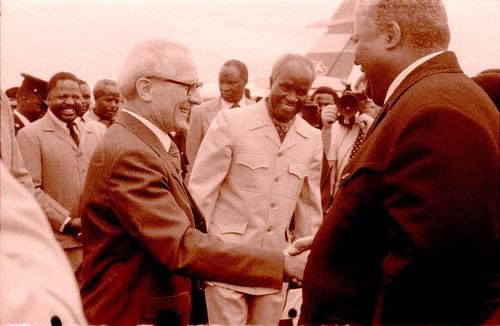
When Joshua Nkomo arrived in East Berlin in March 1977, East Germany received him as a visiting head of state. Photographs published by ZAPU’s Zimbabwe Review show Nkomo shaking hands with Erich Honecker, leader of the German Democratic Republic. But the relationship captured in that photograph had not begun in 1977. By then it was already about 15 years old.
Documents cited from the former East German archives show that contacts between ZAPU and the GDR date to 1962, when the nationalist movement was still finding its way after the banning of the National Democratic Party and the formation of ZAPU.
At first, East German officials were cautious. A 1962 GDR assessment regarded ZAPU as organisationally weak and still influenced by anti-communism. Nevertheless, East Germany considered the Federation of Rhodesia and Nyasaland important enough to warrant long-term attention. Officials recommended helping ZAPU build its organisational structures through printing, material assistance, visits and training. In September 1962, 12 young people from Southern Rhodesia were invited to the GDR for vocational training, while scholarships were offered to ZAPU students.
Then came Edward Ndlovu.
On this topic
Ndlovu, ZAPU’s representative in Cairo, visited East Germany in 1962. His visit appears to have been a decisive early moment in the relationship. By then, the Rhodesian authorities had banned ZAPU and detained Nkomo and other leaders. The East German Solidarity Committee agreed to provide goods worth about 70,000 East German marks. However, at this stage it rejected a ZAPU request for explosives and weapons. Ndlovu later wrote to the Solidarity Committee to express ZAPU’s appreciation.
Finding common ground
ZAPU and the GDR came from significantly different historical circumstances, but by the late 1960s and 1970s they increasingly spoke a similar political language.
East Germany defined its foreign policy in Africa around support for movements it considered anti-colonial and anti-imperialist. In public statements, Honecker repeatedly presented the struggles in Rhodesia, Namibia and South Africa as part of an international confrontation with colonialism, racism and apartheid.
ZAPU, meanwhile, moved increasingly towards socialist language. Its ideological material described colonialism and capitalism as linked, and by the 1970s it explicitly presented scientific socialism as the basis of its political and economic programme.
East German analysts noticed the convergence. An archival study based heavily on Stiftung Archiv der Parteien und Massenorganisationen der DDR im Bundesarchiv.( SAPMO) and foreign Ministry records say ZAPU’s analysis of Zimbabwe’s conflict in terms of social and economic structures was closer to the GDR leadership’s Marxist worldview than the positions it attributed to ZANU at the time.
International networks also pulled the two together. ZAPU had close relations with Kenneth Kaunda’s UNIP in Zambia and with South Africa’s ANC, both organisations with which East Germany had established strong solidarity links. ZAPU also participated in organisations such as the Afro-Asian People’s Solidarity Organisation, the World Peace Council, and the World Federation of Trade Unions.
Ndlovu, Moyo and Silundika
Before Nkomo became the public face of the relationship in East Berlin, other ZAPU leaders did much of the foundation. Edward Ndlovu opened important early doors.
Jason Ziyaphapha Moyo, then ZAPU treasurer, spent an extended period in East Germany between April and June 1964. East German archival records describe the visit as a turning point that raised relations to another level. By July that year, officials of the ruling Socialist Unity Party, the SED, were considering formal party-to-party relations with ZAPU.
T.G. George Silundika was another central figure. In June 1966, he briefed officials of the GDR Solidarity Committee about developments in Rhodesia and ZAPU’s strategy. He explained that the movement intended to mobilise its forces and challenge the image of stability projected by Ian Smith’s government. ZAPU argued that armed action had become inevitable.
East German assistance was also surprisingly practical. In 1964, ZAPU asked for motorcycles, bicycles, and radio telephones; a mobile radio transmitter; badges, flags, and clothing material; help from legal experts in drafting constitutional proposals; university and vocational scholarships; and training for radio operators, printers, typesetters, and mechanics. In 1965, East German experts offered to help ZAPU prepare constitutional proposals for negotiations with Britain.
From blankets to guns
The character of East German support changed as the Rhodesian conflict moved towards war.
Early supplies included blankets and medicines. The East German trade union federation, the FDGB, offered scholarships and later provided clothing, office materials and equipment.
After Rhodesia’s Unilateral Declaration of Independence in 1965, material assistance expanded substantially. Planned assistance to ZAPU increased from 87,000 to 175,000 East German marks.
Then came weapons.
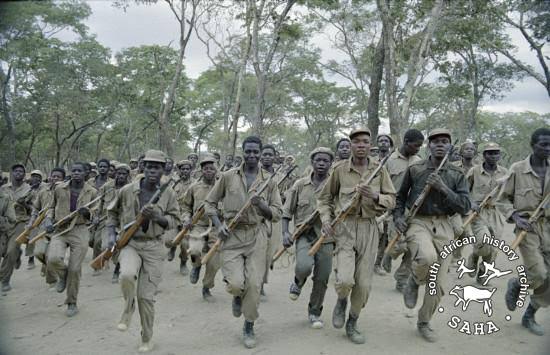
In January 1967, the SED Politburo decided to allocate ZAPU 3,200 Karabiner 98k rifles, 75 MG-34 light machine guns, 470,000 rounds of ammunition, 40 sniper rifles, 60 Kalashnikov-type submachine guns, 50 MP43/44 weapons, and 1,000 anti-personnel mines. Military assistance was therefore not simply rhetorical solidarity.
Nkomo and Honecker
The relationship entered its most intensive phase after a ZAPU delegation visited East Germany in December 1976 and concluded an agreement establishing direct cooperation between ZAPU and the SED.
Three months later, Nkomo travelled to East Germany. On 7 March 1977, Neues Deutschland, the SED newspaper, recorded his meeting with Honecker. It reported Honecker praising Zimbabwe’s struggle against the Smith government and reaffirming East German support. Nkomo also met Foreign Minister Oskar Fischer.
Surviving East German records show the discussions went much further. The SED Politburo agreed to expand political and material support for ZAPU. East Germany would help print information and propaganda material, strengthen the production of Zimbabwe Review, arrange regular Interflug flights carrying supplies, provide technical and economic training and expand educational opportunities.
The two sides also agreed on military assistance, “non-civilian goods” and the training of “special cadres.”
When Nkomo returned to the GDR in May, discussions included establishing a permanent ZAPU office in East Berlin. In September 1977, the first group of 30 ZAPU members entered an SED party school in Dresden. Further groups followed in 1978/79 and 1979/80.
By 1978, ZAPU had opened its Berlin office. Neues Deutschland identified Albert Ndindha as its head in March that year.
Another key intermediary was Kurt Krüger. Krüger repeatedly wrote to Nkomo regarding solidarity flights and assistance. In February 1978, Neues Deutschland reported that Nkomo hosted Krüger at his Lusaka residence and publicly thanked East Germany for its support.
The airlift
Perhaps nothing demonstrates the scale of the relationship more clearly than the 1979 airlift.
From March to May, East German Interflug aircraft flew 50 missions from Luanda to Lusaka, transporting about 512 tonnes of material for ZAPU. Archival research says the cargo included food as well as arms and ammunition for ZPRA.
The operation came at a terrible cost. On 26 March 1979, an Interflug Ilyushin Il-18 crashed while taking off from Luanda for Lusaka. All four East German crew members and six passengers were killed. The operation nevertheless continued.
In June, Nkomo met East German Defence Minister Heinz Hoffmann and requested weapons, vehicles, uniforms, anti-aircraft equipment and military advisers. Hoffmann handed over a prepared consignment of 1,000 submachine guns and 250,000 rounds of ammunition. He declined to send military advisers to Zambia, but offered further training for ZAPU military cadres in East Germany.
By then the relationship had moved far beyond the blankets and scholarships of 1962. It encompassed diplomacy, education, political training, communications, publishing, refugee relief, transport, weapons and military training.
And it survived into the final negotiations over Zimbabwe’s independence. During the Lancaster House talks in 1979, the GDR embassy in London assisted the ZAPU delegation. East German ambassador Karl-Heinz Kern later recalled passing information from Berlin to Nkomo about developments around the conference.
For East Germany, ZAPU had become one of its most important liberation-movement partners in Africa. For ZAPU, the GDR had become something equally valuable: a state willing not simply to issue declarations of solidarity, but to provide the infrastructure that allowed a movement in exile to function , from printing presses and schools to aircraft and guns.
The photographs of Nkomo and Honecker shaking hands in Berlin therefore capture only the visible part of the story. Behind that handshake was a relationship built over almost two decades, involving diplomats, organisers, soldiers, students, trade unionists, aircraft crews and a network of people stretching from East Berlin and Dresden to Lusaka, Luanda and the ZAPU camps of Zambia.





Leave a Reply