
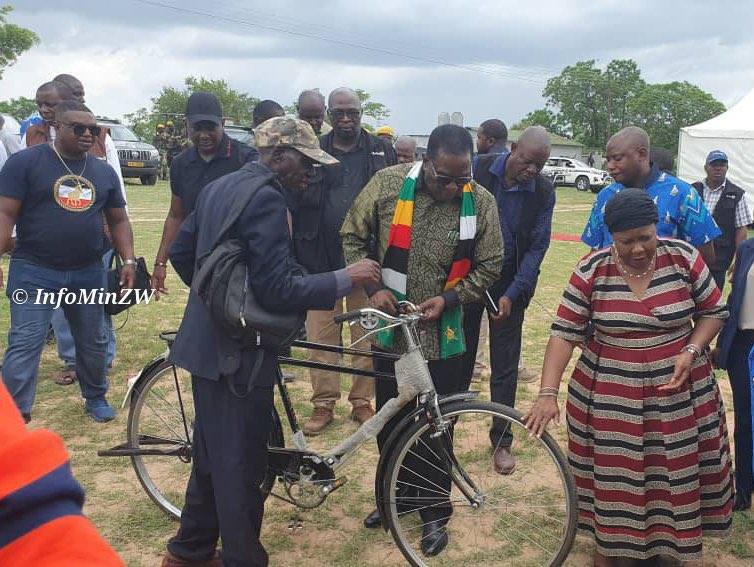
Minister of Veterans of the Liberation Struggle Affairs, Monica Mavhunga, has defended the distribution of bicycles and other small donations to war veterans, arguing that such items, while not genuine empowerment, serve a practical welfare purpose and cannot be rejected when offered by benefactors.
“We agree that bicycles are not what we call empowerment of war veterans,” Mavhunga said during an interface meeting with veterans held at Stanley Square on Saturday.
“There are three veterans who received state of the art houses and because we call other comrades to come witness, we can’t allow them to go back empty handed. We look for donations in the form of hampers or bicycles so that they go back with something.
“True empowerment is about finding ways for veterans to empower themselves using national assets.”
On this topic
However, the minister explained that bicycles and hampers are often provided by well-wishers during outreach programmes.
“When we hold these meetings, we call for support from benefactors. If someone brings something, we cannot refuse,” she said.
The minister suggested that even modest items could still serve useful purposes.
“A bicycle may not be useful to everyone, but it can be given to a child to run errands. A gift can be useful to someone, even if not to another,” she added, noting that such donations come from private individuals and organisations, not government coffers.
Her remarks came in response to growing frustration among war veterans, who voiced anger over what they described as “token” handouts from politically connected businesspeople, arguing that donations such as bicycles, hampers and small cash amounts fall far short of meaningful empowerment and amount to disrespect.
During the same meeting, a faction leader of the Zimbabwe National Liberation War Veterans Association (ZNLWVA), Ethan Mathibela, criticised the culture of dependency fostered by donations.
“We don’t want to be given money by (controversial businessperson Kuda)Tagwirei. We want to generate our own income because we have resources across the country. We want to participate in the mainstream economy. We don’t want bicycles, you don’t respect us,” he said to loud applause from attendees highlighting the deep-seated frustrations among war veterans.
Mathibela also contrasted the war veterans’ situation with that of senior government officials, pointing to the allocation of high-end vehicles to ministers as an example of what he termed “real empowerment.”
“(Finance Minister) Mthuli Ncube should have been here because he has decided to give ministers state-of-the-art vehicles, that is empowerment. But here we are, most war veterans are full-time pedestrians,” Mathibela said.
He stressed that such welfare meetings need to have relevant officials who could answer their concerts,
“We want to find out why from Mthuli, he has to answer. If he doesn’t grant us money, allow us to go into the streets, demonstrating is our constitutional right. We are not demonstrating to topple a government, we are simply saying ‘you are not doing enough for the people who brought power to you.’”
Mathibela also warned against the politicisation of donations, accusing some political actors of using handouts to influence loyalty and deepen divisions within the veterans’ community.
“Disunity is brought by politicians who come here giving us bicycles so that we support them,” he said.
“We didn’t go to war to fight for tribes or factions.”
Beyond economic concerns, Mathibela raised issues around political space and engagement, alleging that some meetings organised by veterans were being disrupted by law enforcement.
“Our meetings are not secret, but the police come and block us. Last time we had paid for a meeting here at Stanley Square, and police came on horseback to stop us,” he said.
“This is not a relationship that reflects unity. There can be no unity where there is segregation among comrades.”
He further criticised the lack of direct engagement with key decision-makers, arguing that the absence of senior officials at such meetings reflected a disconnect between policymakers and ordinary veterans.
“There is a disconnection between suffering war veterans and the relevant authorities. We should be discussing our welfare meaningfully, but there is no connection,” he said.
Mathibela also questioned transparency within structures meant to benefit veterans, including an investment vehicle linked to the Veterans of the Liberation Struggle Board.
“(Retired Major-General Gibson) Mashingaidze leads an organisation on investment and we are stakeholders, but we don’t know the roadmap. It has been more than five years without public accountability,” he said.
In response, the minister outlined other forms of support aimed at improving veterans’ livelihoods, including housing schemes and land ownership initiatives.
She said some veterans had already benefited from state-of-the-art housing, while others were being supported through access to title deeds at significantly reduced costs.
“War veterans receive up to an 85 percent discount on title deeds, while ex-detainee have a 30 percent discount and war collaborators 15 percent discount. This is a critical form of empowerment because it gives them ownership and security,” she said.
Mavhunga also addressed broader economic constraints, noting government efforts to support veterans must be understood within the context of national challenges.
“We need to uplift these discussions from just government obligations. The country has been under sanctions, but the economy is growing and we will continue engaging,” she said.
On the contentious issue of national hero status, Mathibela had earlier raised concerns about perceived inconsistencies in how recognition is conferred.
Mavhunga acknowledged the concerns, noting the final decision rests with President Emmerson Mnangagwa, but pledged to relay the veterans’ views.
“We will take your opinions forward,” she said.
The minister also called for unity among war veterans, warning that internal divisions were undermining their collective bargaining power.
“The chef wants to engage with you, but you are not united. The divisions are giving him a headache. You must find each other,” she said.
On allegations of police interference, Mavhunga said the matter would be taken up with law enforcement authorities.
“The police have their considerations, but we will engage them on these concerns,” she said.







Leave a Reply