
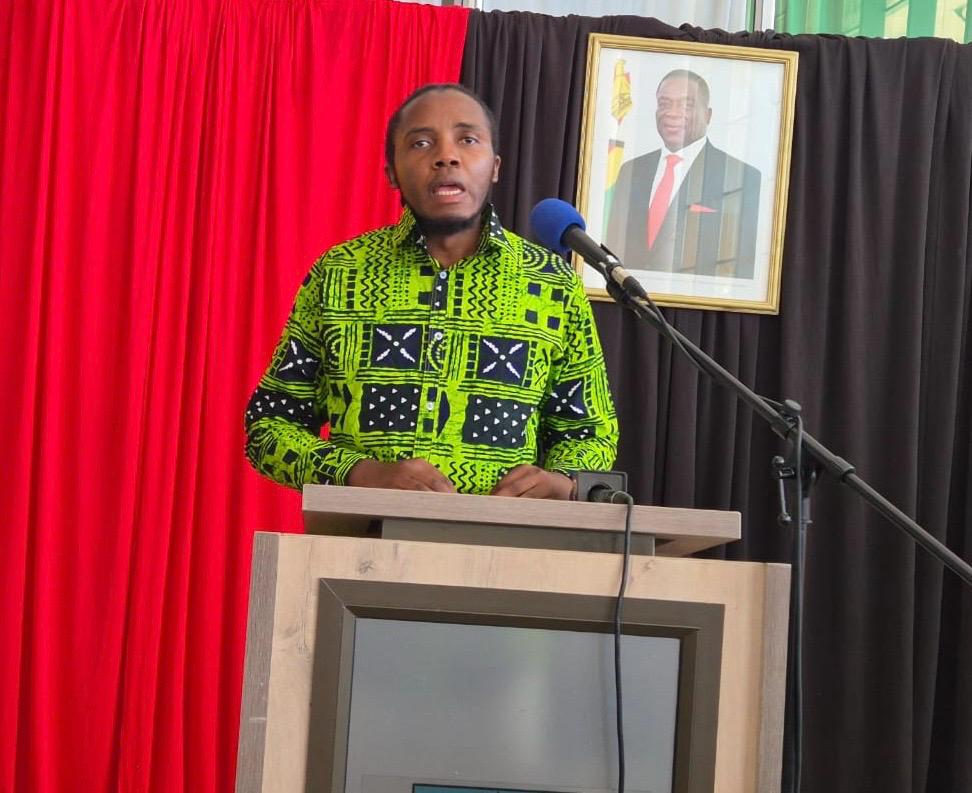
Political science scholar and Pan-Africanist, Richard Mahomva, has claimed that the proposed Constitutional Amendment Bill No. 3 is more about securing the long-term institutional survival of Zanu PF than about extending President Emmerson Mnangagwa’s tenure.
Delivering a public lecture on the amendment bill at the National University of Science and Technology (NUST) in Bulawayo on Friday, Mahomva argued that the proposals must be understood within the broader context of party continuity rather than individual ambition.
He also claimed that President Mnangagwa finds himself in a difficult position, caught between his personal stance and the expectations of his party.
Mahomva stated that while the President has publicly stated that he will “persuade the persuaders” not to push for him to remain in office beyond 2028, this position appears to contradict Zanu PF resolutions.
On this topic
“Because he is a member of a political party, he is governed by the rules of that political party, so he cannot act according to his own wishes and his own will,” Mahomva said, referencing comments by Zanu PF Legal Secretary, Paul Mangwana, who recently indicated party decisions could override individual preferences, warning that “external discipline” could be applied if members act contrary to party resolutions.
The lecture comes at a time when Zimbabwe is debating Constitutional Amendment Bill No. 3, which stems from Zanu PF’s resolutions and proposes changes to the electoral system, including extending the presidential term from five to seven years.
Mahomva said the proposal, which draws from resolutions made at Zanu PF’s 2024 and 2025 National People’s Conferences, reflects a broader strategy to preserve the party’s institutional relevance.
“Zanu PF leadership continuity proposal from the party’s recent National People’s Conferences of 2024 and 2025 is a more complex case of preserving the institutional existence of the party than an individual who, on many occasions, has insisted that he will persuade the persuaders not to persuade him to be in office beyond 2028,” he said.
Mahomva cited remarks by Mangwana, who indicated that party decisions could override individual preferences, warning that “external discipline” may be applied if members act contrary to party resolutions.
“The President has said it on record that he will persuade the persuaders not to make him stay in office beyond 2028, but there lies this man’s problem,” Mahomva said.
“As confirmed by Paul Mangwana, there is a political party to which he belongs, and he is governed by its rules.”
Drawing on historical context, Mahomva cited remarks by former President Robert Mugabe in 1977, who distinguished between “internal” and “external” discipline within the nationalist movement.
“Mugabe explained that internal discipline is an individual’s ability to make correct decisions, while external discipline applies when those decisions are deemed incorrect by the party, resulting in corrective action,” Mahomva said.
He argued that Mnangagwa’s current stance may fall within the realm of internal discipline, but could clash with party expectations if it contradicts formal resolutions.
“President Emmerson Mnangagwa finds himself in a serious predicament , he is in a fix, he is between a hard place and a rock. Whilst he has set the record that he is going to persuade the persuaders based on whether that is internal discipline on his part or something internal within him or whatever, there is another interesting dimension that he can’t act according to his own wishes and his own will,” Mahomva said.
He added that if the party adopts a resolution to extend the presidential term, any office holder would be expected to comply with that institutional decision.
“And Paul Mangwana says if (President Mnangagwa) decides to act to the contrary, external discipline would apply because he belongs to a political party that has principles. When that political party elected in the resolution to expand the Presidential term, it meant that anyone who is given custody over the office of the Presidency should conform to what the institution wants not what they want,” Mahomva said.
Mahomva added that if Zanu PF formally adopts a resolution to extend the presidential term, any office holder would be expected to comply with that institutional position.
“If he decides to act to the contrary, external discipline would apply, because he belongs to a political party that has principles,” he said.
“When the party resolves to expand the presidential term, it means anyone entrusted with that office must conform to what the institution wants, not what they personally prefer.”
Mahomva also defended the proposed extension of the electoral cycle, arguing that it aligns with the fundamental purpose of political parties to retain power.
“The expansion of the electoral life cycle is going to create institutional longevity for Zanu PF,” he said. “Some in the media and on social media argue that a seven-year cycle is problematic, but the primary function of political parties is to remain in power.”
He argued that opposition to such measures from within the party would be contradictory to its core mandate.
“Those who oppose this within Zanu PF risk being seen as acting against the party’s interests,” he said.
“There is a level of ideological inconsistency and lack of political literacy when members fail to understand why political parties exist.”
According to Mahomva, the proposed changes should be viewed through the lens of institutional survival rather than individual ambition.
“So that is going to expand the longevity of Zanu PF,” he said.






Leave a Reply