
By Justice Alfred Mavedzenge
After the removal of former President Robert Mugabe in 2017 through a military coup, the current President of Zimbabwe, Emmerson Mnangagwa, is now being accused by critics of leading another form of political takeover, this time of a different kind. Civil society organisations and constitutional lawyers argue that Zimbabwe’s democratic space has progressively narrowed, with allegations of increasing executive control over the security sector and key state institutions.
According to these critics, President Mnangagwa is now moving toward what they describe as a final stage: pursuing constitutional changes that could allow him to remain in office beyond his current term by altering existing term-limit provisions.
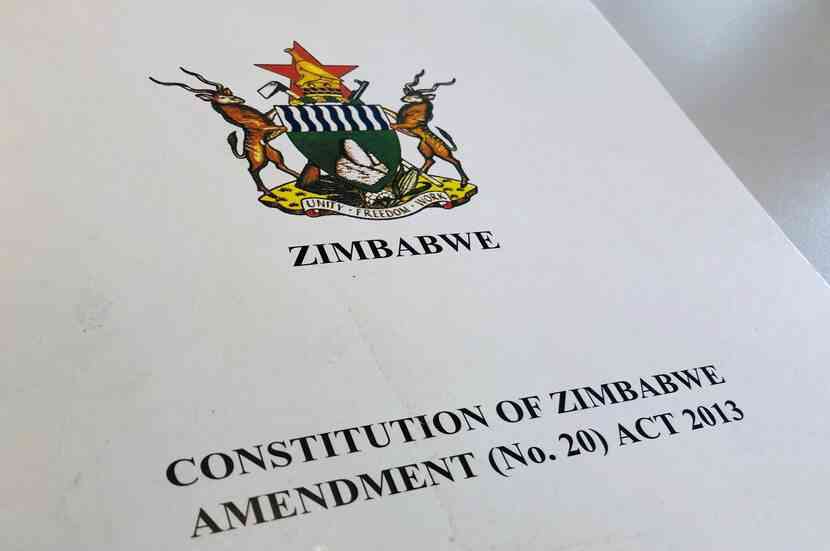
Under the current Constitution of Zimbabwe, President Mnangagwa is serving his final term, which ends in September 2028. On 10 February 2026, President Mnangagwa and his Cabinet approved a proposal to introduce a raft of constitutional amendments that would significantly alter the basic structure of the Constitution without seeking the approval of Zimbabweans, as required by the country’s Constitution.
On this topic
The proposed changes include extending the presidential term of office from five years to seven years in order to postpone elections due in 2028 and allow President Mnangagwa to remain in office at least until 2030. Critics argue these constitutional changes are being pursued without due process. Under section 328 of the Constitution, any amendment of term limits must be approved by Zimbabweans through a referendum, and even if approved, such changes may not be applied to benefit incumbent office holders. These constitutional protections were designed to prevent incumbents from extending their mandates without popular consent.
In direct violation of these democratic safeguards, President Mnangagwa and his Cabinet have resolved to amend term limits without holding a referendum and have further resolved that the changes must benefit the incumbent President, Emmerson Mnangagwa.
Instead of submitting the proposal to a referendum as required by the Constitution, the government has resolved to table it in Parliament. Parliament will conduct public consultations; however, unlike a referendum, public views are not legally binding. Parliament is unlikely to reject the proposed amendments because Members of Parliament (MPs) also stand to benefit by extending their own terms until 2030 without facing elections.
For several years, opposition parties and civil society organisations have alleged that President Mnangagwa’s administration has taken steps that have weakened opposition parties, including the use of constitutional provisions to facilitate the recall of some opposition Members of Parliament. As a result, political analysts say the current Parliament is largely dominated by legislators aligned with the ruling party and the President. Some observers, therefore, argue that any parliamentary debate on proposals that could extend his term may be unlikely to result in significant resistance.
The proposed constitutional changes have been in the making for some time. They were initially advanced by a faction within ZANU-PF in 2024. President Mnangagwa publicly denied that he intended to extend his term, while simultaneously allowing and empowering that faction to campaign for it. He dismissed party leaders who opposed the proposal. On 10 February 2026, he formally confirmed what many Zimbabweans had long suspected: he chaired a Cabinet meeting that approved the proposal to extend his term without holding the constitutionally required referendum.
Implications for the regional and international community
President Mnangagwa’s planned constitutional amendment violates several provisions of the African Union law. Of particular relevance is Article 23(5) of the African Charter on Democracy, Elections and Governance (ACDEG), which prohibits undemocratic changes to constitutional term limits. Revising term limits without holding a constitutionally mandated referendum constitutes an undemocratic alteration of the Constitution and therefore amounts to a planned Unconstitutional Change of Government under African Union norms.
To the extent that these proposed changes seek to postpone the 2028 general election without the approval of Zimbabweans, they also violate the right to self-determination guaranteed under the African Charter, including the right of peoples to freely choose their government. Beyond legal violations, the planned constitutional amendment has serious socio-economic consequences for the region and the international community.
Africa is currently grappling with a resurgence of Unconstitutional Changes of Government following the wave of military coups in recent years. As I argue in my academic work, “Revisiting the African Union’s Strategy on Unconstitutional Changes of Government in Africa”, military coups are often symptoms of prior constitutional and electoral coups. Afrobarometer’s recent survey found that 77 per cent of Africans support constitutional term limits and 80 per cent reject one-man rule, yet many citizens no longer trust elections as a means of removing bad leaders because incumbents manipulate term limits and rig electoral processes.
States that experience constitutional coups frequently later experience military coups, as citizens turn to the military to remove entrenched regimes. In 2025, the then SADC Chair and President of Madagascar, Andry Rajoelina, was removed through a publicly supported military coup after mounting an electoral coup to remain in power. Earlier in 2023 in Gabon, President Ali Bongo was toppled by a military junta shortly after declaring himself the winner of a contested election with 64.27 per cent of the vote. In Zimbabwe, former President Mugabe was removed through a publicly supported military coup in 2017 after entrenching himself through constitutional and electoral manipulation and capturing democratic institutions.
Military coups are notoriously difficult for the African Union to reverse because they often enjoy public support and require military force to undo, which risks further instability. If the African Union is to succeed in curbing military coups, it must take strong preventive action against constitutional and electoral coups. This requires the application of sanctions under the ACDEG to deter leaders who seek to manipulate constitutions to prolong their rule. Such leaders endanger not only their own countries but also regional democracy and stability.
Constitutional coups also undermine the rule of law and fuel corruption, thereby weakening economic development and deepening poverty. This directly undermines the AU’s Agenda 2063 and the United Nations Sustainable Development Goals, particularly on eradicating poverty through sustainable growth. There can be no sustainable development in Zimbabwe if one individual is permitted to extend his term in office without due process.
Leaders who subvert constitutions do so because they lack sufficient public support to win democratically. According to the recent Afro Barometer survey, 52% of the respondents expressed dissatisfaction with President Mnangagwa’s performance, signifying a significantly low level of popularity for him and his government. Poor government performance has been attributed to government corruption. In the latest Corruption Perceptions Index Zimbabwe scored 22/100, due to endemic and systemic corruption in the public sector. Critics and political analysts warn that if constitutional changes were used to extend President Mnangagwa’s term, it could undermine the rule of law and would not necessarily address concerns about corruption.
According to the World Bank, 49 per cent of Zimbabwe’s population lives in extreme poverty. Public hospitals lack basic medicines. Civil servants such as teachers and nurses earn as little as US$250 per month. In this context, President Mnangagwa’s administration has drawn widespread anger for purchasing luxury vehicles and distributing them to socialites, religious leaders, and senior politicians. Even supporters of ZANU-PF have expressed discontent. The President is fully aware that Zimbabweans would reject his proposal in a referendum, which is precisely why he is attempting to bypass it.
If this constitutional amendment succeeds, the region and the international community are likely to face an increase in economic migration from Zimbabwe. Already, approximately 30 per cent of Zimbabwe’s population lives in the diaspora due to economic collapse. South Africa hosts about three million Zimbabweans, while Botswana hosts roughly 100,000, driven abroad by deteriorating socio-economic conditions at home.
A constitutional amendment will also further erode the rule of law and weaken protection for foreign direct investment. Investors already face bribery demands and disregard for property rights from politically connected elites. Many Zimbabweans are investing in neighbouring countries because of the absence of legal certainty at home. Capital flight and reduced foreign investment will constrain economic growth and undermine Zimbabwe’s ability to service its external debt, including obligations to the IMF and the African Development Bank. This is why everyone must be concerned about Mnangagwa’s planned constitutional amendment in Zimbabwe
What is to be done?
Although the primary responsibility for resisting this constitutional amendment lies with Zimbabweans, they cannot succeed without regional and international solidarity. President Mnangagwa has enacted laws and policies that close the democratic space. Latest assessments of civic space in Zimbabwe by CIVICUS show that those who speak out face torture, imprisonment, or death, while constitutional bodies such as the judiciary and the Human Rights Commission do not enjoy sufficient autonomy to protect citizens’ rights. There is virtually no domestic space for dissent in Zimbabwe.
In this context, regional leaders must hold President Mnangagwa accountable for his obligation to refrain from engaging in an Unconstitutional Change of Government, especially considering that Zimbabwe experienced another Unconstitutional Change of Government recently in 2017.
Regional civil society, labour movements, farmers’ organisations, and student unions should express solidarity with Zimbabweans and urge their governments to discourage this plan. If such an amendment is allowed in Zimbabwe, it is a question of time before similar processes take place in neighbouring States. Former liberation movements in the region, including the ANC, SWAPO, and FRELIMO, must also be engaged.
The African Union, and particularly the Peace and Security Council, has an obligation under Article 4 of the AU Constitutive Act to engage President Mnangagwa and dissuade him from pursuing this unconstitutional path. Beyond SADC and Africa, the international community, acting under the United Nations Charter, must hold President Mnangagwa to account.
It is the duty of Zimbabweans across the political spectrum to engage multilateral institutions and international stakeholders and to alert them to the impending constitutional change and its consequences for Zimbabwe, SADC, the African Union, and the wider international community. President Mnangagwa must be encouraged to rise above the occasion and transform into a Statesman rather than continue as a political competitor. If he respects the constitutional term limit, he will go down in the history of the country as the first leader to peacefully hand over power at the end of his term.
Dr Mavedzenge is a constitutional and international law scholar and lawyer. He is also a Senior Researcher in the Democratic Governance and Rights Unit, University of Cape Town. He writes in his personal capacity.





Leave a Reply