
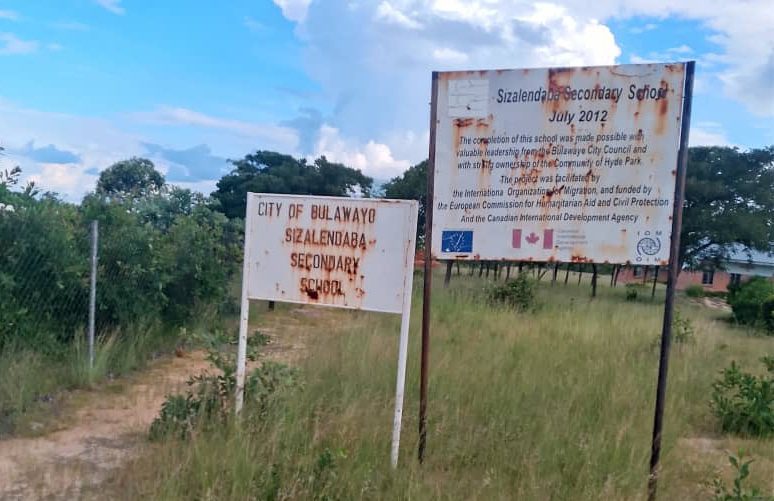
Residents of Mazwi village in Ward 17, on the outskirts of Bulawayo, say Sizalendaba Secondary School has seen little meaningful development more than a decade after it was handed over to the Bulawayo City Council (BCC), raising fears that hundreds of learners are being denied basic educational facilities.
The school, established in 2012 through a partnership between the community, donors and government, was transferred to the local authority to improve access to secondary education in the peri-urban area. But community leaders say the expected investment has not materialised.
“This school has remained stagnant since it was given to council,” Mazwi village head Zvenyika Murapamoyo told CITE. “The two classroom blocks you see were built by the community with support from donors and government. Council was supposed to take over and develop the school, but nothing has changed.”
Sizalendaba is the only secondary school under BCC, and residents say it still operates without a science laboratory, electricity, sports fields or specialist rooms for technical subjects such as building, woodwork and metalwork.
On this topic
Murapamoyo said the lack of facilities has directly affected learner performance and skills development.
“The school has no laboratory, no electricity and no blocks for technical subjects. Learners are struggling because they are only taught theory. Even a building class that once existed collapsed after the teacher was transferred to council projects,” he said.
Parents also accuse the council of failing to honour repeated promises to construct additional classroom blocks, a laboratory and teachers’ accommodation.
Out of five planned teachers’ cottages, only one is complete, and residents say they finished it themselves, including roofing.
“We dug the foundations four years ago and paid villagers using our own funds,” Murapamoyo said. “Every year we are told there is a budget, but up to now nothing has been done. You can even see tall grass around unfinished structures.”
Former student Wisdom Jere, who sat for his examinations at the school in 2023, said pupils are disadvantaged compared with their peers elsewhere.
“I wrote Science and got a C because there is no lab. We only learnt theory,” he said. “There are no sports fields, no computers and no electricity. Children who are not strong academically have nothing else to fall back on.”
Ward 17 councillor Sikhululekile Moyo confirmed that development at Sizalendaba Secondary School has stalled.
“It is true that the school was built in 2012 and up to now it only has two classroom blocks and one finished teachers’ cottage,” she said. “There is no sporting ground and other essential facilities, and this contributes to poor learner performance.”
Moyo said she requested a site visit by fellow councillors after raising the issue in council chambers, so that decision-makers could better understand the scale of the problem.
Teacher accommodation, she added, is a key concern.
“If teachers have accommodation, results may improve because they will not have to travel long distances. The road is bad and transport challenges cause late arrivals. This discourages teachers from staying at the school,” Moyo said.
Support CITE’s fearless, independent journalism. Your donation helps us amplify community voices, fight misinformation, and hold power to account. Help keep the truth alive. Donate today





Leave a Reply