
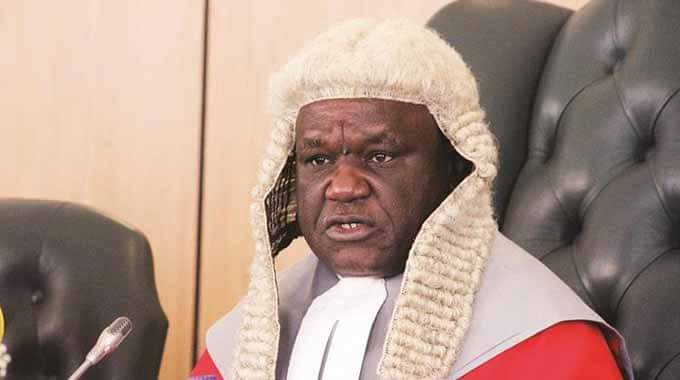
Zimbabwe’s Chief Justice Luke Malaba will retire from office on 15 May 2026, bringing to an end a tenure that was legally contested and politically charged following his controversial extension beyond the constitutional retirement age.
The Judicial Service Commission (JSC) confirmed in a press statement dated 17 January 2026, that Justice Malaba “will be retiring from his positions as Judge and Chief Justice on 15 May 2026, his last working day will be at midnight on 14 May 2026.”
This announcement effectively closes a chapter that has dominated Zimbabwe’s legal and political discourse since 2021, when Malaba’s tenure was controversially extended after he reached the mandatory retirement age of 70.
Malaba had technically ceased to hold office on May 15, 2021, upon turning 70, as stipulated by Zimbabwe’s Constitution before the extension was effected.
On this topic
However, Zanu PF used its parliamentary majority to amend the law, allowing the President to extend judges’ retirement age to 75 if deemed fit.
Under Section 186(1) of Zimbabwe’s Constitution, a Chief Justice who reaches the age of 70 may elect to extend their tenure by up to five years and the JSC said Malaba exercised this option, stating that he “elected to extend his tenure by an additional five years.”
Malaba’s extension also followed the 2021 constitutional amendments that removed public interviews for senior judges and expanded presidential discretion in judicial appointments.
While the JSC has presented Malaba’s retirement as a routine constitutional event, his exit comes after years of public controversy surrounding the extension of his term beyond the constitutionally prescribed retirement age, a move that civil society groups, legal experts and opposition argued fundamentally altered the independence of the judiciary.
At the time, legal watchdogs, civil society organisations and opposition figures warned the amendments were tailor-made to secure Malaba’s continued stay in office.
The amendments were widely criticised as undermining the principle of separation of powers, with the judiciary increasingly viewed as vulnerable to Executive capture.
Although the Constitutional Court upheld the legality of the extension, governance analysts noted the ruling effectively endorsed constitutional tailoring, setting a precedent in which institutional rules could be adjusted midstream to benefit sitting office-holders.
“The constitution was never followed in the Malaba matter and unfortunately Zimbabwe allowed that to happen, when it should not. Even if there was a change to the constitution, it should have been made clear that those already sitting in office would not benefit. But that did not happen, the process was manipulated,” said Dr Vusumuzi Sibanda, a legal expert, while reacting to Malaba’s retirement announcement.
Dr Sibanda said this manipulation shows how certain processes operate in Zimbabwe.
“Those in power corrupt the system and it remains the same people in the Executive. Because the Judiciary is filled with beneficiaries of the same Executive, they do not serve the interests of the people, but the interests of the Executive,” he said.
“As a result, they dance to the tune of their appointer. There is no real separation of powers between the Judiciary and the Executive. People in the Judiciary serve at the pleasure of the Executive, and the courts end up dancing to the Executive’s tune.”
The legal expert said those who engineered the changes were effectively rewarding Malaba for legally sanitising “the 2017 coup and everything that followed.”
“They deliberately looked the other way and made no effort to ensure that things were done properly. For that reason, we are saying Malaba was kept in office unlawfully, which is the root of the problem we face today. And now we are seeing Mnangagwa attempting to do the same,” Dr Sibanda said.
Another analyst, Mxolisi Ncube, said Malaba’s departure was ‘long anticipated,’ however it does little to undo the institutional harm caused during his extended tenure.
“The controversy was not about Malaba as an individual, but about the precedent set when constitutional rules are bent to accommodate those already in power,” he explained.
“The concern is that the judiciary was restructured to suit political convenience. Even with Malaba’s retirement, those structural changes remain and they will continue to affect judicial independence unless deliberately reversed.”
Ncube said with Malaba’s retirement having been dated, attention turns to who replaces him and how that process unfolds.
Observers also noted how Malaba’s tenure coincided with a period where the courts were repeatedly accused of legitimising disputed electoral outcomes and Executive overreach, particularly in politically sensitive cases such as the 2018 election case brought by then opposition leader Nelson Chamisa against Zanu PF’s Emmerson Mnangagwa.
This election petition popularised debate around the ‘missing V11’ result forms, with the opposition MDC Alliance arguing the 2018 vote was marred by “mammoth theft and fraud,” alleging that ballot boxes had been contaminated.
In a unanimous judgment, the nine Constitutional Court judges dismissed the petition, ruling that it lacked sufficient evidence.
Delivering the verdict, Justice Malaba described the allegations of tampering as “bold and unsubstantiated,” stating the judges wanted to “drink from a poisoned chalice,” as the petitioners’ best evidence would have been the contents of the ballot boxes themselves.
Meanwhile, the JSC used its retirement statement to also rebuke sections of the media, particularly over reports that Malaba had been required to go on leave pending.
“There is no legal obligation for the Chief Justice to proceed on pre-retirement leave. The decision to take leave is discretionary not mandatory,” the Commission said, adding that describing his decision not to do so as a “refusal” was “erroneous and creates a false impression of impropriety.”
The JSC added that preparations for the transition are underway and will be conducted “in accordance with the law and established judicial practice,” dismissing claims of institutional inertia.
“It is also inaccurate to suggest that no preparations are being made for the transitions. The relevant legal provisions clearly outline the procedures to be followed when the Chief justice retires and this will be executed in accordance with the law and established judicial practice.”
Justice Malaba’s retirement on 14 May 2026 will be marked by a special sitting of the Constitutional Court and a formal dinner hosted by the JSC, celebrating his four decades in the judiciary, from Magistrate, Judge. Judge of Appeal to Chief Justice.
Support CITE’s fearless, independent journalism. Your donation helps us amplify community voices, fight misinformation, and hold power to account. Help keep the truth alive. Donate today







Leave a Reply