

As the whole world grapples with climate change, Zimbabwe feels the heat, too. But while the country rolls up its sleeves to tackle the adverse impact, its responses and capacity to manage the impact were sometimes conveyed through false narratives and propaganda.
This investigation by ZimFact, with support from Code for Africa, highlights a coordinated campaign that promoted false claims about the Zimbabwean government’s handling of the El Niño fallout in 2024. It also examines how the Zimbabwean government communicated the facts on grain production between 2023 and 2024, in reaction to the impact of the crisis.
In May 2023, the World Meteorological Organisation (WMO) announced that El Niño conditions had developed in the tropical Pacific for the first time in seven years, setting the stage for a likely surge in global temperatures and disruptive weather and climate patterns.
In Southern Africa, the impacts of El Niño have been felt across all sectors – from food security to nutrition, agriculture, water and sanitation, energy, health and education. This has led to the suffering of vulnerable populations and economic contraction.
On this topic
At the time of the WMO announcement, Zimbabwe was preparing for the beginning of the 2023-2024 rainy season, which would also mark the start of the summer cropping season.
Eight years prior, in 2016, then President Robert Mugabe had declared a state of disaster following a drought in the country, which was triggered by El Niño, after 2.44 million people were declared to be struggling for food.
During this period, 75 percent of the country received less than normal rainfall, leading to crop failures and a cereal shortfall of 1.5 million tonnes. In the 2023/2024 agricultural season, El Niño would have a similarly devastating impact, but the misleading narratives surrounding this would lead to confusion and public distrust.
On April 3, 2024, Mugabe’s successor, President Emmerson Mnangagwa, declared a State of Drought Disaster due to the severe food situation attributed to the El Niño effect. In a post on X, President Mnangagwa wrote: “We are mobilizing resources to assist affected communities and mitigate the impact of this natural disaster. We stand together in solidarity during these challenging times.”
This announcement received mixed responses on social media, as some people questioned the sincerity of this plea, considering the same government had reported that the country had recorded surpluses in food production in the 2022/2023 season.
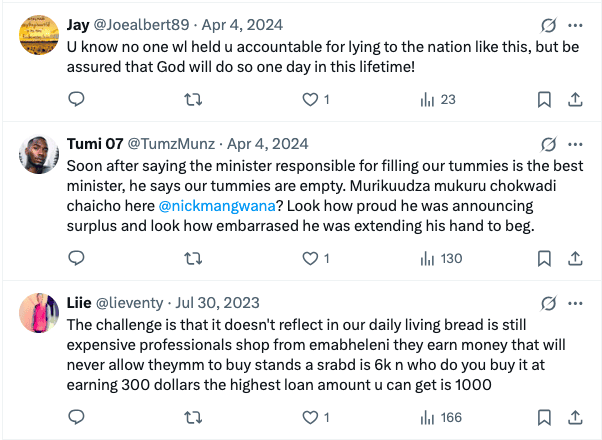
Screenshot of some responses to the X post by the President of Zimbabwe (@edmnangagwa).
In a video posted on X of President Emmerson Mnangagwa’s speech at the Dakar Africa Food Summit in January 2023, before the onset of El Niño, he declared that Zimbabwe had devised elaborate strategies to ensure the country was food secure despite climate change.
“A country must eat what it kills, that is village wisdom. Now in Zimbabwe, we have problems of food insecurity and we said how much food do we want per year to feed our country,” he remarked. “We know we need about 2,000,000MT of grain, so we say, because there is climate change, how many hectares of land can we put under irrigation to produce 2,000,000+ MT to feed the nation, and we determine how much yield does a hectare have. Once you have done that, you now know the amount of hectarage you need to put under irrigation to achieve the amount of grain you need to feed your nation in spite of climate change. That [is what] we have done and we are now food secure.”
Furthermore, in March 2023, ZBCNewsonline reported that Zimbabwe had despatched 300 Metric Tonnes of mealie meal to Malawi as relief following the impact of Cyclone Freddy, suggesting self-sufficiency.
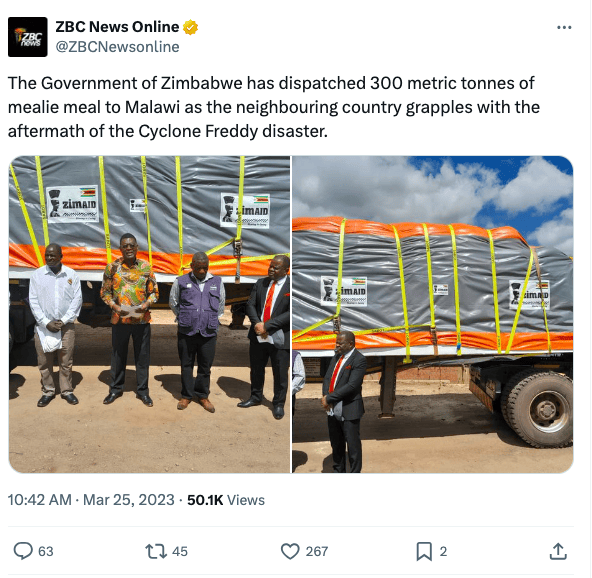
Screenshot of an X post by ZBC News Online reporting Zimbabwe’s food donation to Malawi.
Likewise, on July 29, 2023, Nick Mangwana, the permanent secretary in the Ministry of Information, Media and Broadcasting Services, reaffirmed that the country had a maize and wheat surplus in a post on his X profile, which would subsequently be screenshotted and circulated widely.
He wrote, “Forget about the Maize Surplus. We have that alright. Forget about the fiscal surplus. That’s no longer breaking news. For the first time ever, we have a wheat surplus of 40000MT. How about that? Does anyone still doubt these results that speak for themselves?” The post was reposted a hundred times and viewed by over 74,000 people.
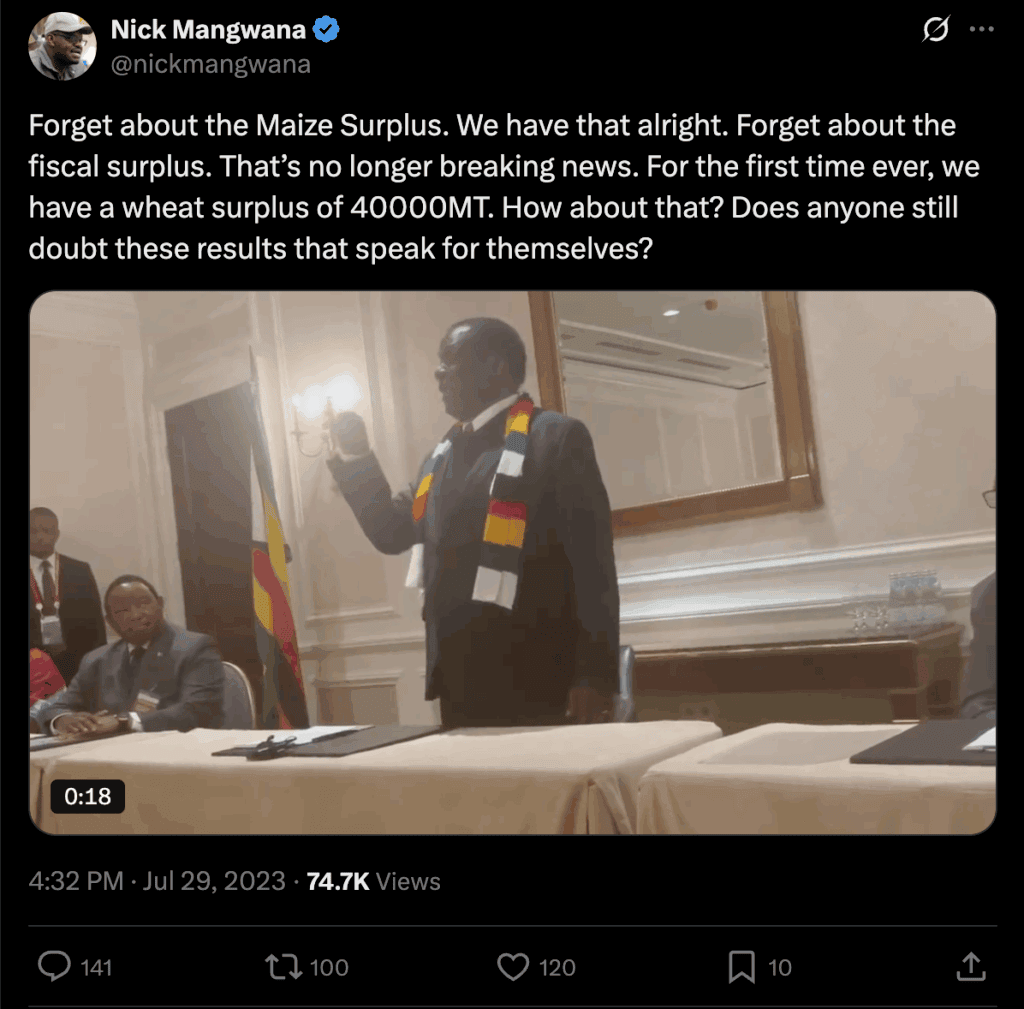
Screenshot of the X post by Nick Mangwana (@nickmangwana).
Despite the posturing of self-sufficiency on social media, this narrative was questioned by many who wondered where the surplus was coming from when people in the country were wallowing in poverty and the country was still relying on aid from the international community.
One user on X questioned why the government was receiving grain from the Russians if the country had a surplus.
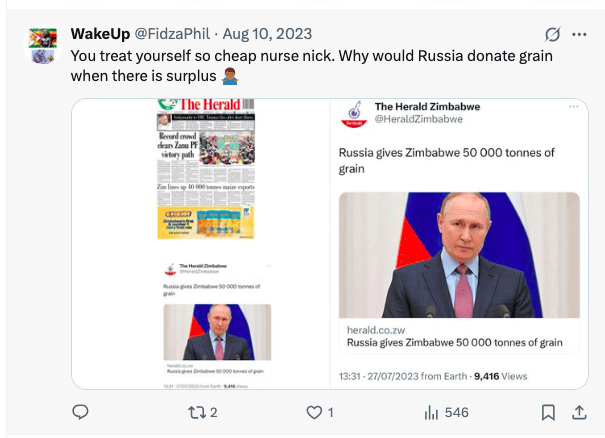
Screenshot of post by @FidzaPhil on X questioning the accuracy of the government’s declaration.
Further investigation by ZimFact showed that in 2024, Zimbabwe experienced a 59% decline in maize production compared to the 1552 Metric Tonnes produced in 2023. This marked a 68% deficit in the country’s projected annual consumption of 2000 Metric Tonnes. Interestingly, Zimbabwe had a 25% surplus in wheat production, surpassing the 450 Metric Tonnes annual consumption target in 2024.
Maize and Wheat production and consumption patterns in Metric Tonnes (2023-2024)
| Crop | Annual Consumption | 2023 | 2024 | % change | Deficit/ Surplus |
| Maize | 2000 | 1552 | 635 | -59% | -68% |
| Wheat | 450 | 420 | 564 | +32 | +25% |
Source: Zimbabwe Economic and Fiscal Report 2023 and 2025
In other words, while social media messaging gave the impression that the country had recorded a grain surplus in the run-up to the 2023/2024 agricultural season, official documents revealed a huge deficit in maize production.
The sharp contrast in narratives shared by top government officials on social media and records from government reports reflects a need for factual and transparent communication and consistent messaging from the government to keep the public up to date on the country’s state of affairs during natural disasters like El Niño.
Meanwhile, despite President Mnangagwa’s declaration of a state of drought disaster after the 2023-2024 agricultural season, the government continued to downplay the impact of El Niño on the national economy.
The Minister of Lands, Agriculture, Fisheries, Water and Rural Development, Dr. Anxious Masuka, erroneously declared that although the 2023/2024 drought caused by El Niño was the “worst since Independence”, its impact was not being felt because of the mitigation strategies put in place by the government.
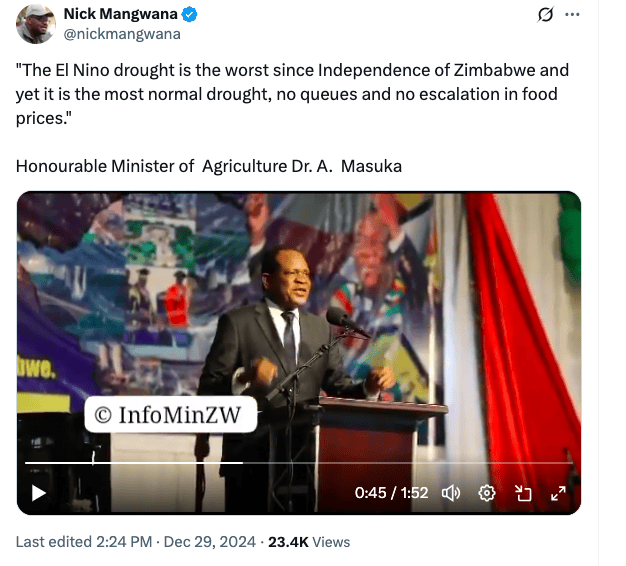
Dr Anxious Masuka’s claim was shared on X by Nick Mangwana (@nickmangwana) on December 29, 2024, attracting over 23,000 views.
This message was amplified in December 2024 by a coordinated group of cyber-activists called “varakashi”, an intricate web of activists known to promote cyber-propaganda on behalf of the government and the ruling Zanu PF party on X. Accounts perceived to be members of this group re-shared the above post on “X” (for example, here, here, here, here and here), applauding the minister’s efforts despite his claims being misleading.
The accounts reshared the post and tagged other varakashi for amplification. The identified five accounts have a combined 18,785 followers and mostly focus on promoting pro-government narratives. Some of the top Varakashi accounts are @ZanuPF_Patriots and @Varakashi4ED, which have 139,303 followers and often seed the narratives promoted by the smaller accounts.
First, the minister claimed that last year’s drought was the worst the country had experienced since it gained independence. However, whilst the El Niño-induced incident of 2023-2024 ranks as one of the most severe droughts in Zimbabwe since 1990, statistics from the Meteorological Services Department (MSD) show that the worst recorded drought in Zimbabwe occurred in 1991-1992, which caused devastating damage to crops and livestock.
The claim that prices did not escalate during the peak of the disaster was also false. The Africa Development Bank and Zimbabwe Statistics Agency (ZIMSTAT) placed Zimbabwe’s inflation at 29.4% in December 2023 and at 57.5% in April 2024.
The remarks by the minister gave the impression that the impact of El Niño was contained as a result of proactive measures to minimise its impact. However, the reality was that the country had benefited from reactive measures such as maize imports from neighbouring South Africa, donations from China, India and Russia, as well as aid from international agencies.
This is outlined in a report by @SABCNews, which highlighted that more than half of Zimbabwe’s population was food insecure, needing aid to sustain themselves until March 2025. The post featured villagers from Chivi receiving cereals and cooking oil just before Christmas in 2024.
The claims that there were no queues and escalation of food prices in the country were dispelled by individuals who provided context to explain the absence of visible queues at retail shops. Since 2022, some of the country’s top retailers, OK, Pick‘n’Pay, Choppies and Spar, have downsized or shut down as a result of worsening economic conditions, unfavourable exchange rate policies, and a surge in competition from the informal market, which has fuelled the sprouting of tuckshops importing foodstuffs from South Africa.
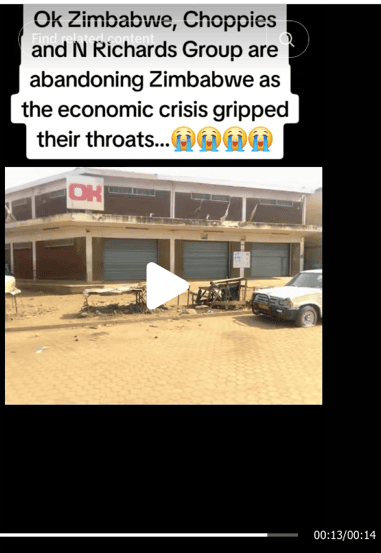
Screenshots of posts made on X (Twitter) and TikTok showing the challenges being faced by retailers.
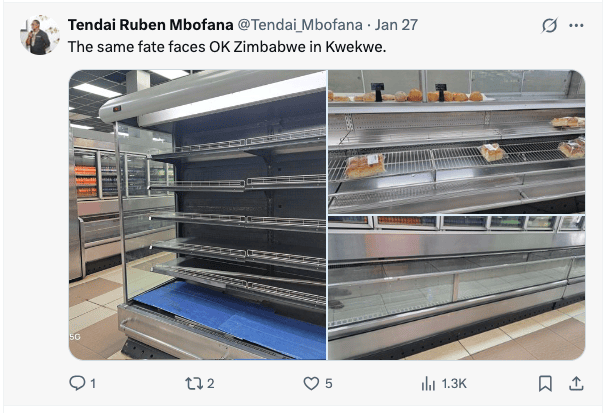
Screenshot of an X (Twitter) post showing empty shelves at OK Zimbabwe’s Kwekwe branch.
As a result of the above challenges, the top retailers sometimes did not have the capacity to stock their shelves with basic commodities, hence the absence of queues.
In January 2024, Daily News reported that Zimbabwe was facing serious mealie meal shortages, forcing agricultural authorities to grant grain millers permission to import maize to improve local corn meal supplies.
Accountability and transparency are key principles in crisis communication, which help to build trust in public institutions. ZimFact observed that some of the government’s communications in the run-up to and during the height of the El Niño-induced drought were misleading to the public, as they did not provide an accurate depiction of the situation in the country. It is therefore prudent for government departments to adopt a communication-for-development approach, which helps the nation adapt and respond to the pressures of climate change disasters, such as El Niño, from an informed perspective.
This article was produced with mentorship from the African Digital Democracy Observatory (ADDO) as part of an initiative by the Ministry of Foreign Affairs of Norway and Code for Africa (CfA). Visit https://disinfo.africa/ for more information.





Leave a Reply