
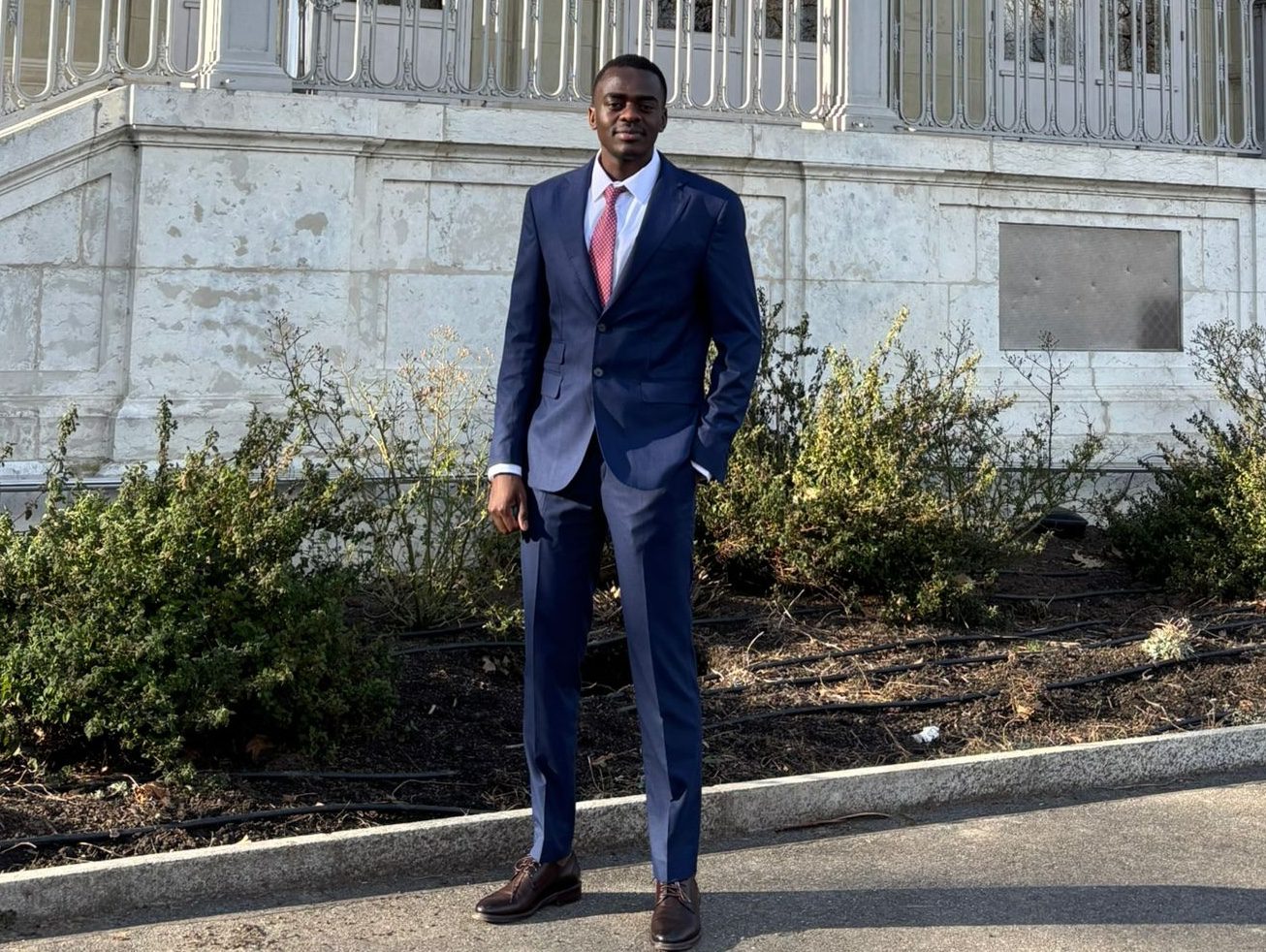
A 25-year-old scholar from Gwanda, Lisang Nyathi, has won the 2025 Henry Dunant Research Prize for his groundbreaking study on protecting children’s right to education in conflict zones.
Nyathi, from Ward 6 in Nyandeni, received the award from the Foundation Prix Henry Dunant in Geneva, Switzerland. The prize honours research that reflects a strong commitment to human dignity, a principle championed by Henry Dunant, the founder of the Red Cross.
Nyathi’s thesis, titled “When Bullets Threaten the Pursuit of Knowledge: Reclaiming Children’s Right to Education in Armed Conflict through a Human Dignity-Centred Approach under IHRL and IHL,” explores how international humanitarian and human rights law can be strengthened to better protect schools and students during armed conflict.
Speaking to CITE, Nyathi said his journey from rural Gwanda to international recognition has been shaped by perseverance and family support.
On this topic
“I completed my O’ Level studies between 2013 and 2017 and was the school’s top-performing student, passing eight subjects despite walking long distances to and from school each day,” he said.
After completing his A’ Levels at Milton High School in Bulawayo with 20 points, Nyathi earned a scholarship in 2021 to study Comparative, European and International Legal Studies at the University of Trento in Italy, graduating in 2024 with top honours. He later joined the Geneva Academy of International Humanitarian Law and Human Rights for his master’s degree.
“I graduated cum laude on October 17, 2025, and was honoured with the 2025 Henry Dunant Research Prize for my thesis,” Nyathi said. “My paper examined how children’s right to education is protected under international humanitarian and human rights law, and how these protections can be made stronger.”
He argued that attacks on schools, destruction of infrastructure, and the disruption of learning during conflicts amount to violations of both legal and moral principles.
“As my paper argues, this underscores the need to strengthen protection. The denial of education during armed conflict should not only be seen as a breach of international law, but also as a direct assault on the humanity of the child,” he said.
Nyathi proposed a “human dignity-centred” framework that views education not merely as a social right but as a fundamental element of a child’s humanity.
“If a human dignity approach is used as part of legal protection, then the right to education would be seen as essential to living a dignified life,” he explained. “Integrating this perspective could make international law more coherent and offer stronger protection for children’s rights.”
His paper also recommends practical measures, such as mainstreaming education as a core humanitarian priority, safeguarding schools through international commitments like the Safe Schools Declaration, and supporting long-term educational recovery in post-conflict settings.
“My hope is that this research, which I am continuing in my PhD studies, contributes to a world where no child’s education is silenced by the sound of war,” Nyathi said.
The award includes a certificate, 5,000 Swiss francs, and an opportunity to publish the research in the International Review of the Red Cross.
At the prize ceremony in Geneva, Etienne Kuster of the Fondation Prix Henry Dunant praised Nyathi’s work for redefining how education is perceived in war.
“For Mr. Nyathi, the destruction or occupation of schools is not a mere collateral tragedy but a direct assault on human dignity,” Kuster said. “He transforms education from an ancillary social right to a core humanitarian concern central to dignity and peace.”
Now pursuing a PhD in Human Rights, Nyathi said he hopes to inspire young people from his community.
“I live my life in the hope that my story shows others in my village that through education, we can go places, no matter where we come from,” he said.
Support CITE’s fearless, independent journalism. Your donation helps us amplify community voices, fight misinformation, and hold power to account. Help keep the truth alive. Donate today





Leave a Reply