
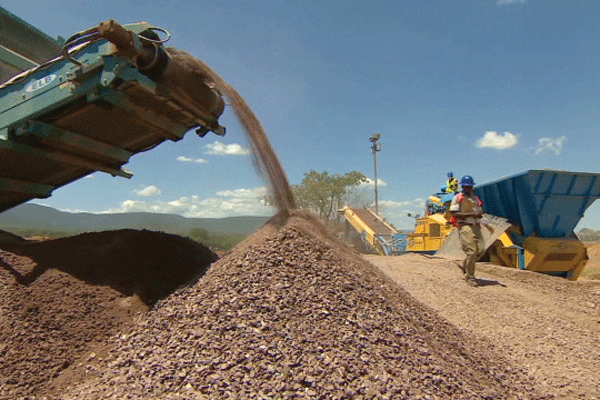
A new report has raised concern over weak transparency and limited community benefits from Zimbabwe’s multibillion-dollar mining industry, despite its central role in the national economy.
The study, Mining and the Development Agenda: An Overview of Revenue Reporting in the Mining Sector, by the SIVIO Institute, found that while mining contributes around 12% to Zimbabwe’s GDP and over 75% of export earnings, its impact on inclusive development remains minimal.
“Do mining activities and revenues contribute towards widespread economic development?” the report asked, warning that mining continues to function “as an enclave in a sea of underemployment, benefiting a few while the majority remain marginalised.”
SIVIO noted that although efforts have been made to improve accountability through local initiatives modelled on the Extractive Industries Transparency Initiative (EITI), key financial data remains hidden from public view. “Gaps still exist in the transparency discourse, as some data is not publicly available, raising questions about the actual revenues generated by the industry,” the report stated.
On this topic
Data from the Mining Revenue Monitoring Index (MRMI) shows that between 2017 and 2024, twelve major mining companies generated a combined US$10.02 billion in gross revenues from platinum, gold, diamond, and chrome mining. Platinum contributed the largest share at US$7.73 billion, followed by gold at US$1.44 billion.
However, only 1% of gross revenues, or about US$1.42 billion, was paid in taxes, while just 2% of net profits were directed toward Corporate Social Responsibility (CSR) programmes. “The CSR contribution remains relatively small compared to the substantial revenues generated by the sector,” the report said, describing this as “a missed opportunity for development in mining-affected communities.”
The report commended Zimplats and Caledonia Blanket Mine for their consistency in reporting CSR investments, noting that “Zimplats has contributed approximately US$30 million towards CSR,” while Caledonia has channelled funds into healthcare and community projects in Gwanda District.
Despite these examples, SIVIO said the sector remains “complex, characterised by competing interests and, at times, borderline criminal accounting methods.” It urged the government to strengthen oversight mechanisms and make mining data publicly accessible.
“Zimbabwe must invest in policies focused on improving revenue accountability and transparency,” the report recommended, calling for Parliament and the Auditor General’s Office to jointly monitor mining revenues and CSR budgets.
The institute stated that while mining remains a key pillar of Zimbabwe’s economy, stronger governance is needed to ensure mineral wealth benefits citizens equitably.
“There is a need for communities to hold companies and the government accountable to ensure that the industry accelerates development,” the report stated.
Support CITE’s fearless, independent journalism. Your donation helps us amplify community voices, fight misinformation, and hold power to account. Help keep the truth alive. Donate today




Leave a Reply