

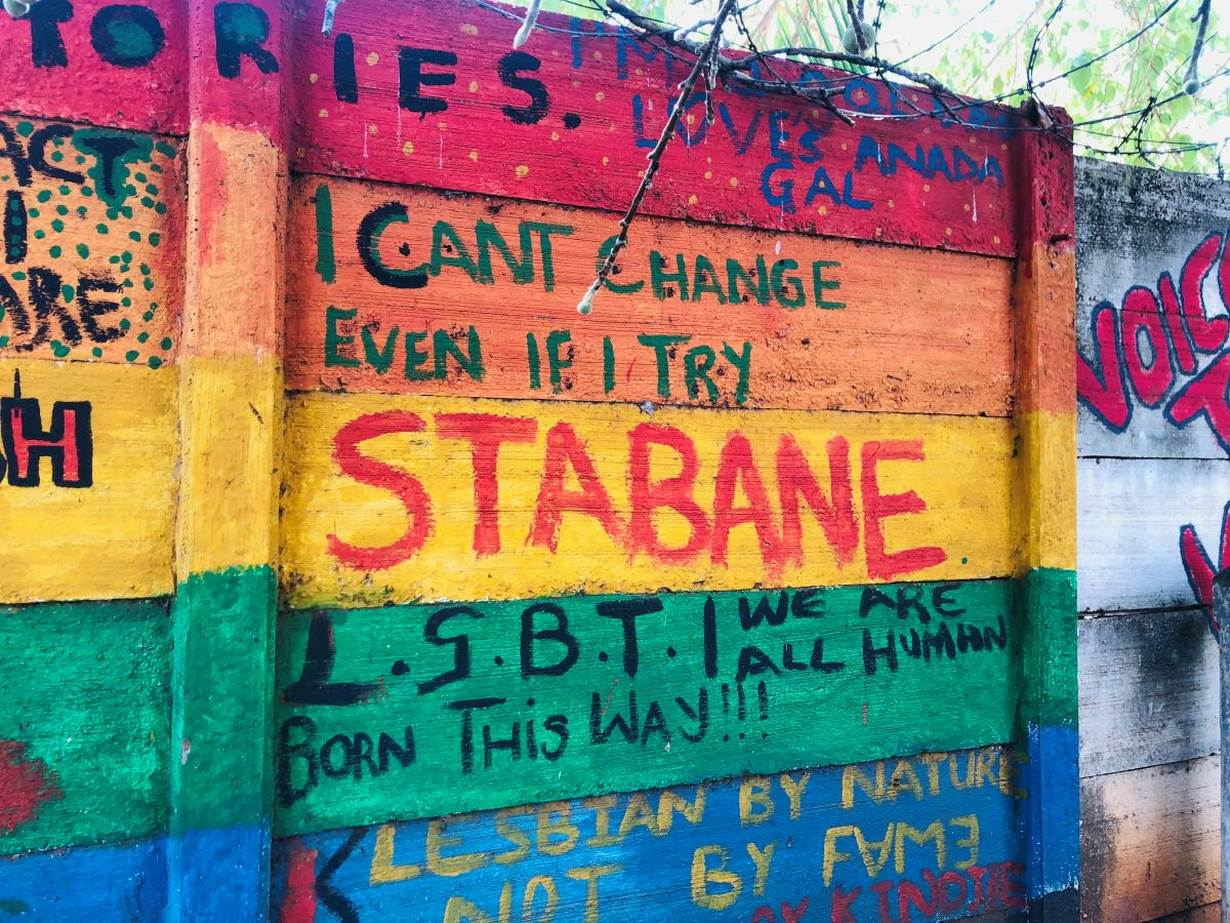
In a new digital world order, where social media posts can lead to direct earnings through advertising revenue sharing, increased brand visibility, customer engagement, audience growth, and other positives, influencers in Zimbabwe are now tapping into the public rage about the lesbian, gay, bisexual, transgender, queer and Intersex (LGBTQI) community in a bid to achieve some of these.
The majority of Zimbabweans, just like many other Africans, still frown upon homosexuality, which is not only outlawed in the country but also generally considered taboo. According to a report published by Afrobarometer in 2024, though tolerance toward homosexuals improved in Zimbabwe between 2014 and 2023, as many as 78 per cent of the population said they would not like to have homosexual people as neighbours — slightly higher than the continent-wide average.
Zimbabwe’s late former president, Robert Mugabe, at one point described members of the LGBTQI community as ‘worse than dogs and pigs.’ Now, given the conservative nature of the Zimbabwean society, conversations that revolve around the contentious subject of homosexuality both online and offline tend to trigger a furore. Slurs such as Ngochani, Ngito, satanic and evil, worse than Satan himself, and others are used in everyday language on social media platforms such as X (formerly Twitter), Facebook, and others, to condemn and discredit homosexuality. Ngochani and Ngito are derogatory terms in the Shona language for people with a homosexual orientation.
This analysis highlights how social media influencers are taking advantage of the public fury in their disinformation campaigns about the LGBTQI members of the Zimbabwean society to attract responses, reposts, likes, and views to not only gain mileage but also boost their X earnings.
On this topic
There are many ways through which X users can monetise their content on the platform, including ad revenue sharing. One needs to be verified with a blue badge and subscribed to X Premium, have at least 500 active followers, and accumulate 5 million post impressions over a period of three months to be eligible. The programme allows users to earn a share of the revenue from ads displayed in the replies to their posts.
On the other hand, brands sometimes pay X users with a significant following to post sponsored tweets promoting their products or services through platforms like SponsoredTweets and PaidPerTweet and connect them with companies looking for Twitter influencers. The other methods include affiliate marketing, X subscriptions (formerly known as Super Follows), promoting or selling products and services, and embedding a store URL in the biography or using direct links in tweets to boost sales.
X account, Solomon Harudzibwi, using handle @S_Harudzibwi, who describes himself on X as a digital strategist with interests in social media management, cites LGBTQI as one of the six subjects used by Zimbabweans to boost their X payouts in this post from August 2023. While Zimbabwe is not yet supported for monetisation on X, meaning creators based entirely in the country typically cannot receive payments directly via the platform, there is a way around that, which involves opening a Stripe account in an eligible country through a relative or friend and using a VPN to change one’s Zimbabwean location.
Although no Zimbabwean has publicly admitted to getting X payouts in the past, many other users across the world have shared their earnings. In 2023, US-based writer Brian Krassenstein, who at the time had about 750,000 followers, claimed that X paid him $25,000. In the same year, SK, a creator with approximately 230,000 followers, claimed to have earned $2,236 from Twitter, while political commentator Benny Johnson, with 1.7 million followers, reported earning $10,000.
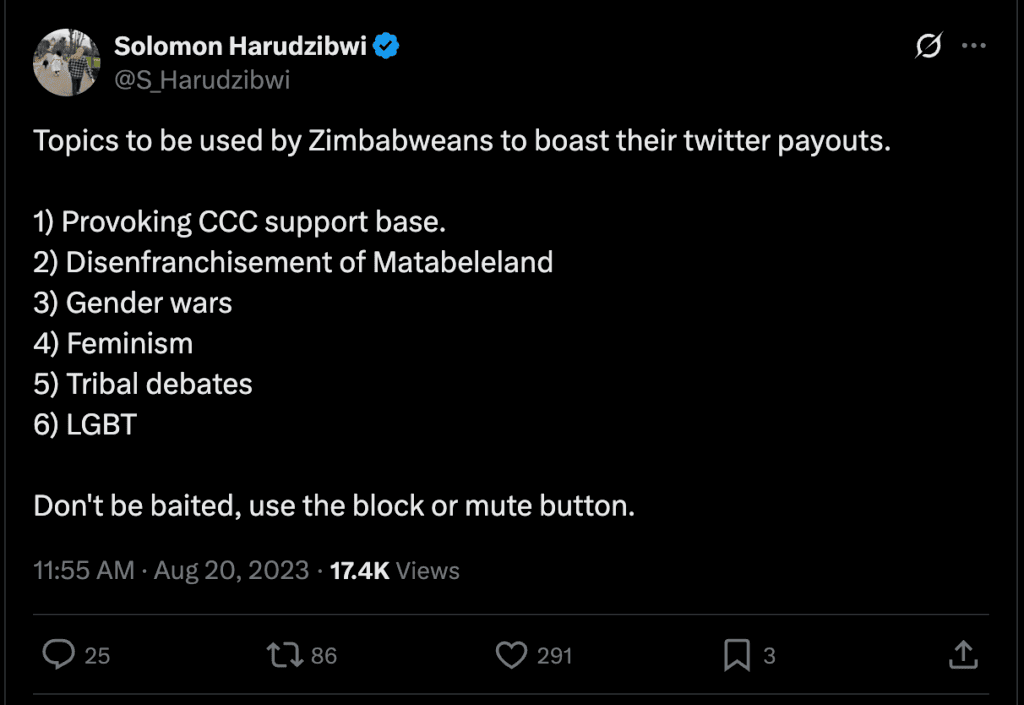
Screenshot of the tweet by @S_Harudzibwi.
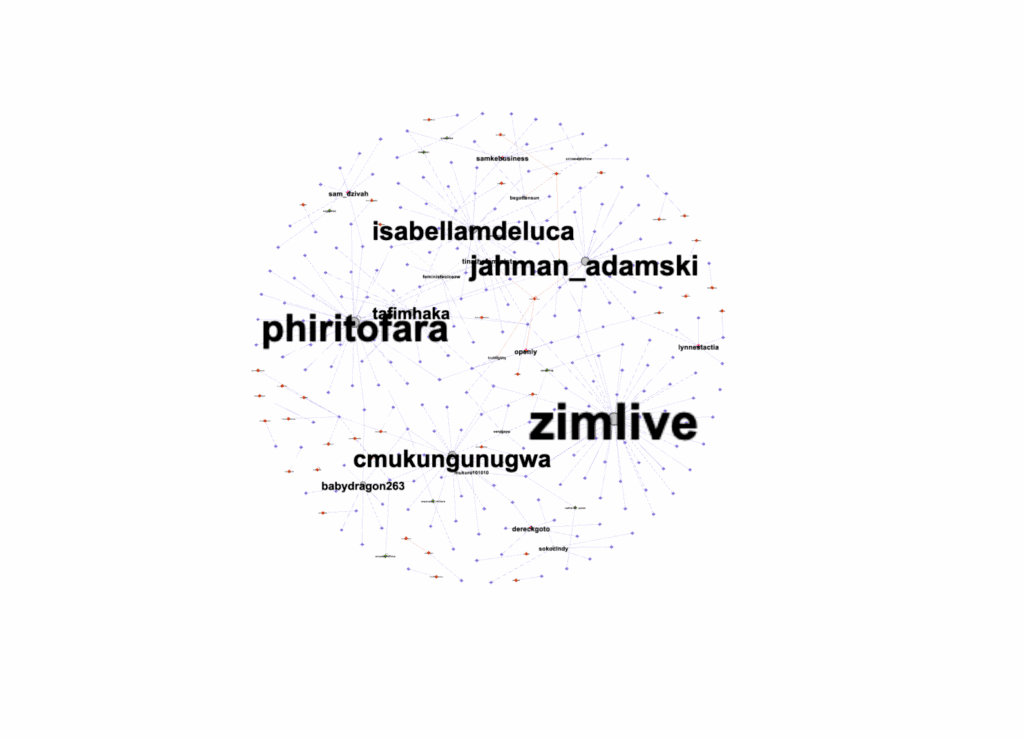
Visualisation of the tweet network around LGBTQI conversations in Zimbabwe.
On 29 July 2024, X account, self-described as a “chief economic analyst and mining project director,” and with strong links to the ruling ZANU-PF party, C. H. MUKUNGUNUGWA, operating under the handle @CMukungunugwa and with over 14,500 followers, posted this message: “Gift Ostallos Siziba has been confirmed to be Gay @Cde_Ostallos Pasi neNgochani (down with homosexuals) All those under the LGBTQ in Zimbabwe should face the Full wrath of the law!!”
Siziba is a former opposition Citizens Coalition for Change (CCC) legislator and deputy national spokesperson. The malicious doxing is accompanied by an image of Siziba seemingly being kissed by another man on the cheek, juxtaposed with other images of the individuals, branded: “LGBTQI- Blue Movement.” The post, tapping into the public rage on homosexuality, sought to discredit the main opposition political party, together with its former leaders, who also include Nelson Chamisa, who was at the time associated with the Blue Movement.
C. H. MUKUNGUNUGWA’s post, sugar-coated with the contentious LGBTQI discourse as a direct attack on CCC and its leadership, for supposedly embracing what is considered taboo in Zimbabwe, was able to generate a massive 30,500 views and 160 interactions. Of the 160, there were 109 replies, 10 reposts, and 41 likes. Some replies, such as the one by Padare-Enkundleni, garnered over 2,000 views. Moreover, the originator of the post would even comment on replies to his post.
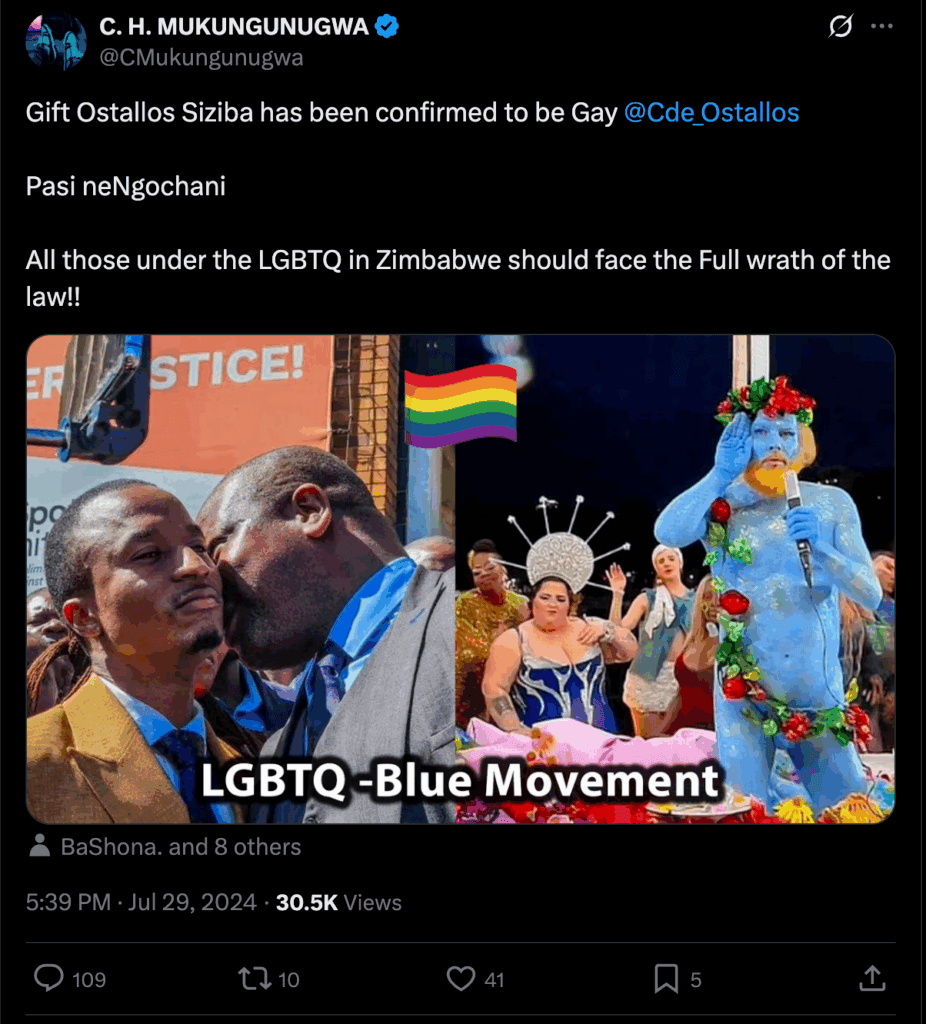
Screenshot of the tweet by @CMukungunugwa.
The following are some of the replies to C.H. MUKUNGUNUGWA’s post.
- Chitova01 @Chitova01193871: Wakazviziva pawakamunyenga akaramba (You got to know it when you proposed love to him and you were rejected) – 1,600 views
- Nobody @bezzeln: This constant fixation is becoming tiresome, comrades. It’s actually embarrassing. If he’s gay, so what? Let him live his truth while you live yours. It’s no big deal. – 810 views.
- Wellington @greatzimbabw: Confirmed by who? Don’t u think its OK to disagree politically, but everything wrong to be vindictive and personal. I will accept and critique your views if I don’t agree, but unnecessary to take this path. – 80 views.
Notably, in one of the replies, account: Lion from the East @gwiriri10 dismisses the post as a content creation gimmick meant to generate money for the influencer. He thus says: “Content creation manyama. After tweeting such you go all smiles to the bank riding a donated car 😂😂”
The same C.H. MUKUNGUNUGWA account had earlier in May 2025 condemned the promotion of the LGBTQI and cross-dressing in a post which read: “Anyone promoting LGBTQ or men wearing dresses in Zimbabwe should face arrest for 5+ years. We must preserve our culture without fear no compromises #ZimbabweanValues #ProtectOurCulture.” The post attracted 75,000 views. The account has also posted LGBTQI-related content in February this year.
On April 17, 2025, X account Redflag ndini🚩(@babydragon263), followed by C.H. MUKUNGUNUGWA, posted a message which read: “Ende mu Zim mazara ma gay anenge achingonyepedzera kunge varume😭😭😭ticharoorwa nani” (For sure, Zimbabwe is full of gays who are pretending to be husbands. Who will marry us?)
The post generated over 63,900 views and 524 interactions. One of the replies to that post by Johnny not Sinns, which attracted 26,000, read: “Hamungazo roorwe mese makawandisa (You will not all get married, you are too many).” Additionally, account Redflag ndini🚩, the originator of the post, went on to laugh off that reply, which garnered 5,100 views. This reveals that some posts are strategically made with certain agendas as opposed to spontaneous responses contributing to the discourse. The same account created at least 16 posts on homosexuals between February and September this year, and in some instances generated views as high as 97,000.
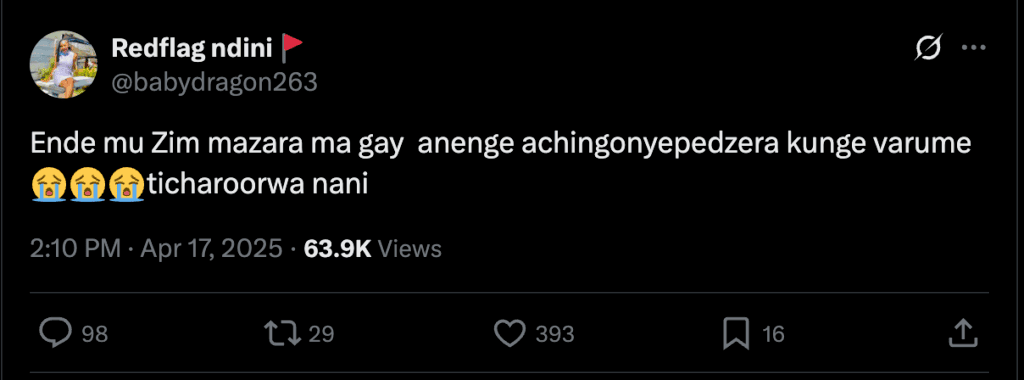
Screenshot of the X post by @babydragon263.
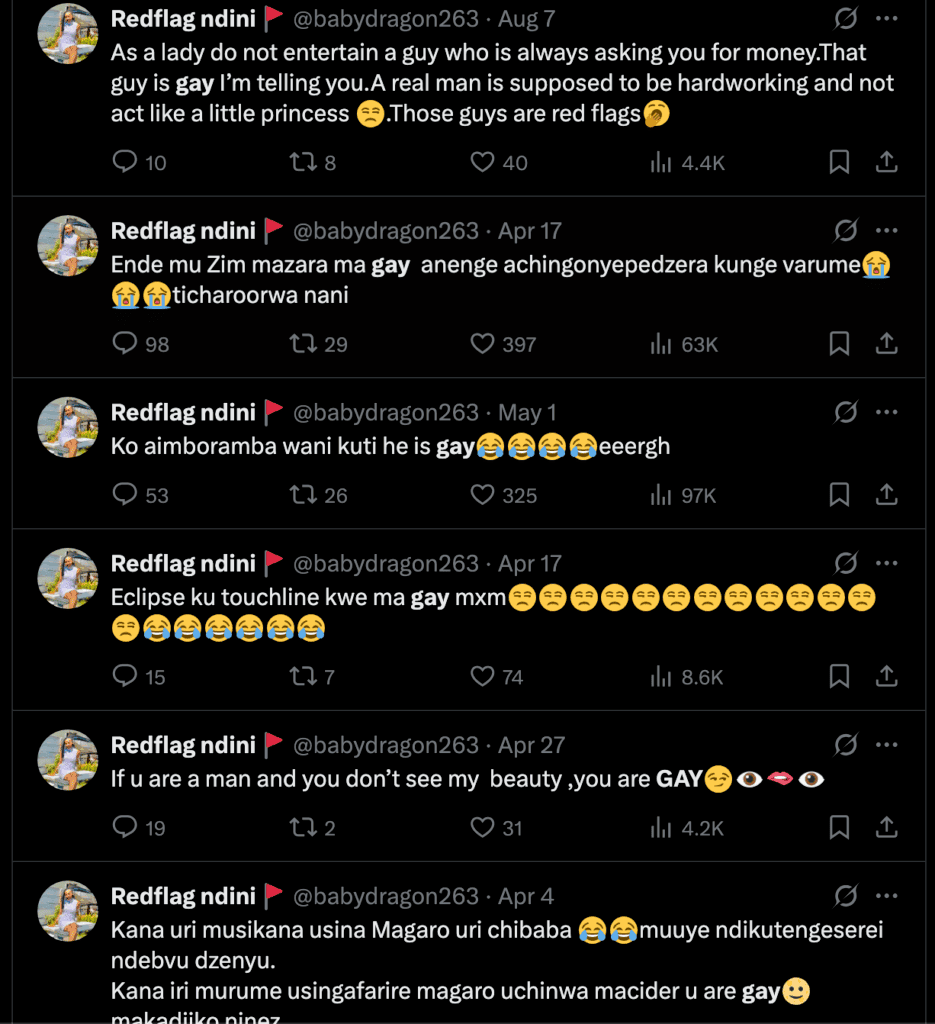
Screenshot of X posts by @babydragon263 where the word ‘gay’ is mentioned.
X account Tafi Mhaka (@tafimhaka), with 25,200 followers, on 16 August 2025, posted this message: “Canaan Banana — Zimbabwe’s First Homosexual President 1/ Canaan Banana: Methodist minister, father, husband. In public, the godly face of the new Zimbabwe. In private, a sexual predator — using the sanctity of State House as cover to hunt male aides, guards, and staff.”
Their post, accompanied by images of Zimbabwe’s first ceremonial president and executive prime minister, Canaan Banana and Robert Mugabe, respectively, standing with their spouses in the early 1980s after independence from Britain, attracted 36,600 views and 172 interactions. The deliberate bringing in of Banana, who was convicted of sodomy, and Mugabe, a fierce critic of homosexuality, successfully brought the much-needed traffic to the account.
The same account had made posts with similar content on 15 March twice and on 13 April the same year. Remarkably, while Tafi Mhaka appears to tweet pro LGBTQI tweets, he also copied and pasted about Canaan Banana. This implies that these influencers are not isolated posters but networked actors feeding each other’s visibility, amplifying moral panic narratives about LGBTQI communities. By latching onto public anger, they mobilise wider participation and make anti-LGBTQI discourse appear mainstream.

Screenshot of the X post by @tafimhaka.
In an X post accompanied by an image, and condemns gays as ‘lunatics,’ account Phrophet DrCde Prof Madzibaba Adamski Jahman (@jahman_adamski) with 69,500 followers, on 5 June 2025, said: “Has anyone noticed gay month isint gaying like it usually gays. People have had enough of the lunatics!” The post reinforced the stereotypes about the rights of members of the LGBTQI community as new and foreign to Zimbabwe. The account identifies itself as a political commentator and business owner. Tapping into the public’s rage about LGBTQI individuals in Zimbabwe, the account generated 3,682 views and 61 interactions.
Moreover, Jahman has made numerous posts between July 2024 and the present publicly denigrating homosexual people and, in the process, attracted many views and interactions.
Another social media influencer of note tapping into the public rage on the LGBTQI community is The Salt of The Earth (@Shadaya_Knight). Some of their posts have attracted views as high as 1,1 million and 236,000. The account with a massive following of 645,500 is taking advantage of that to exploit the anti-LBGTQI discourse to their advantage.
On 17 January 2025, Children of Zimbabwe War Veterans Association (COZWVA), a non-profit organisation, posted a message on X, which read: “Two Zimbabwean men got married in Canada 🇨🇦. These are Timothy Manyengavana Former Manager BakersInn & Polytechnic Professor Innocent Manyoka.” The post attracted a whopping 161,600 views, 360 replies, 86 reposts, 251 likes and 74 bookmarks. While the majority of replies condemned the act, there were a few who supported it, while others remained indifferent. Some questioned if the post was based on a true event or if it was just cooked up.
However, regardless of whatever reply was given, the post stands out as a clear indication that content on LGBTQI individuals resonates well with many Zimbabweans on social media, which explains why influencers continue to exploit it for self-aggrandisement.
The growing influence of social media—particularly X—has reached a point where it cannot be overlooked by anyone aiming to shape public discourse or influence opinion. While many users turn to the platform for real-time news, political updates, and brand engagement, it has also become a powerful tool for those seeking to amplify divisive agendas.
In Zimbabwe, political and social influencers have increasingly leveraged X’s algorithmic reach and financial incentives to drive disinformation campaigns targeting the LGBTQI community. Content related to homosexuality consistently attracts high engagement, making it a strategic focus for those seeking visibility and virality. This calculated exploitation of societal prejudices underscores the urgent need for greater accountability and media literacy in the digital space.
This article was produced with mentorship from the African Academy for Open Source Investigations (AAOSI) as part of an initiative by the Ministry of Foreign Affairs of Norway and Code for Africa (CfA). Visit https://disinfo.africa for more information.



Leave a Reply