


By Arnold Mayibongwe Nkala
Reactions are responses to situations, direct results of something that has happened. One form of reaction is reciprocation: an act that matches the action it responds to. Tit for tat. What goes around comes around. This idea best explains the behaviour of Ndebele King Mzilikazi towards one of his many wives, Queen Loziba Thebe. Oral tradition and written sources state that she was his intandokazi, his favourite wife, suggesting that his deep affection for her was a form of reciprocation.
It is important, however, to distinguish between favourite and favouritism. Being a favourite reflects preference rooted in merit, while favouritism implies undue preference without reason. Queen Loziba became intandokazi through merit. King Mzilikazi, remembered as one of Africa’s great leaders and an adept nation-builder, valued rewarding people based on merit. Through her qualities and hard work, Queen Loziba earned his admiration, making her a timeless role model. This is why she continues to be commemorated every year. This year’s celebrations will be held on 13 September at her gravesite in Kopa.
Queen Loziba, daughter of Phahlana Thebe, was born in the same year as King Mzilikazi. If the widely held belief that Mzilikazi was born in 1790 is accurate, then Queen Loziba too was born in that year. They were true age mates (ontanga).
On this topic
Kopa, her burial site, is a peri-urban area near the growing Inyathi central business district, in Matabeleland North. Historically, it was once King Mzilikazi’s capital, Mhlangeni. The area is rich in heritage: the Ngwingwizi River served as the bathing site for King Mzilikazi, Queen Loziba, and the community. The King had a private pool, while men and women had designated sections. Oral tradition even suggests that the King and Queen may have occasionally bathed together, a testament to their deep love.
Close to Ngwingwizi River stands Inyathi Mission, the oldest surviving Christian mission in Zimbabwe, now a National Monument. Nearby lies Queen Loziba’s gravesite, which, along with the annual commemoration, enhances Kopa’s value as a cultural and tourist destination.
Unlike most women of pre-colonial Ndebele society, Queen Loziba’s grave is located in the male cemetery, next to the kraal. Traditionally, men were buried near the kraal, where livestock were kept, while women were buried in the backyard (esibuyeni), near the spaces where they carried out their domestic roles. By placing Queen Loziba near the kraal, King Mzilikazi elevated her to the status of a man, symbolically granting her the honour, prestige, and recognition usually reserved for warriors, commanders, and heads of households.
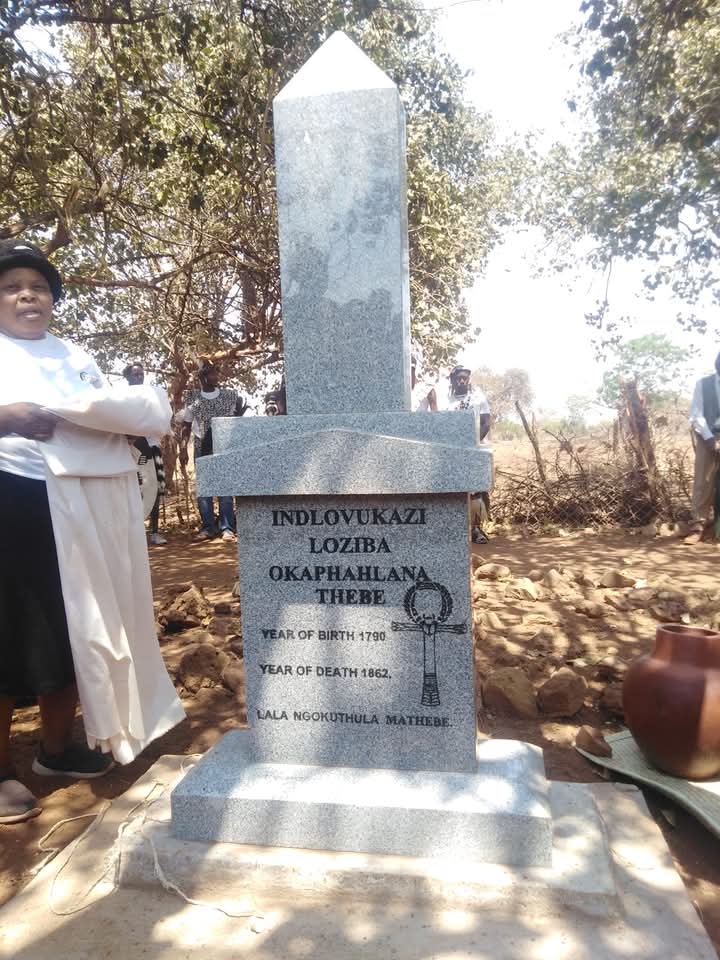
Queen Loziba’s death in 1862 plunged King Mzilikazi into deep depression. Once known for his strength, resilience, and power, he struggled to cope with her loss. The kraal, once a place of pride where he admired his cattle, became a source of sorrow, overshadowed by the sight of her grave. It seemed as though he could not live without her.
Ultimately, the King razed his Mhlangeni residence and relocated to Mhlahlandlela, where he spent the final five years of his life. The move was an attempt to escape the overwhelming grief tied to Queen Loziba’s memory.
Before Queen Loziba’s death, King Mzilikazi ensured that her biological daughter, Princess Lobitshi, was honoured with the highest bride price (amalobolo) in the nation, one hundred cows. Princess Lobitshi married Prince Linganisa, son of Hlubi King Mehlomakhulu. To further honour Queen Loziba, King Mzilikazi promoted Linganisa to General of the Makhanda brigade and Governor of Makhandeni province. Today, this lineage continues as the Siphoso Chieftaincy in Tsholotsho.
As Mzilikazi’s favourite wife, Queen Loziba became his informal chief advisor. Though the patriarchal Ndebele society limited women’s public roles, she exercised significant influence behind the scenes. Her life offers inspiration, particularly for women, proving that influence and leadership are not confined to formal titles. One can lead “from behind,” like a shepherd guiding the flock.
The Queen Loziba Commemoration is not only about remembering one remarkable woman, it has grown into a cultural practice akin to a Ndebele Women’s Day. It is an opportunity to appreciate and inspire women in our communities. Buying a gift for your mother, sister, daughter, or partner on this day is a meaningful way to celebrate their role in society.
I wish you a happy Queen Loziba Day.
Arnold Mayibongwe Nkala is a published author and historian. He writes in his personal capacity.
Facebook: Arnold Mayibongwe Nkala
Email: arnoldmayibongwenkala@gmail.com
Phone: +263 779 626 183






Leave a Reply