
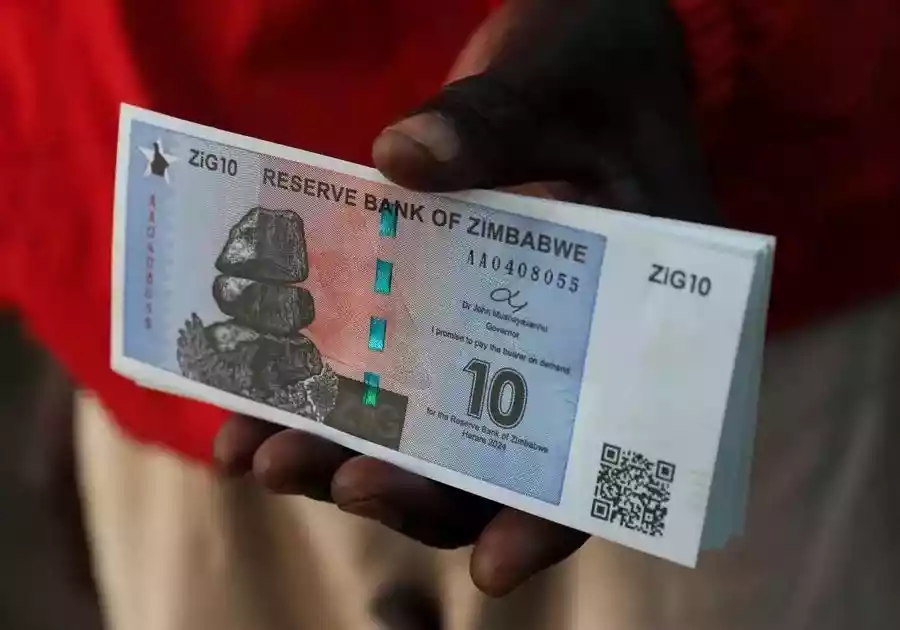
Only 39 293 people have received payments under the Urban Cash for Cereal Programme, a fraction of the targeted 1.7 million individuals, despite government promises to provide financial relief to urban households affected by drought.
The shortfall, Parliament heard, is attributed to limited funds from the Treasury, despite the Ministry of Public Service, Labour and Social Welfare requesting ZiG48.7 million from the Ministry of Finance, Economic Development and Investment Promotion to cover the programme.
This was revealed by the Minister of Public Service, Labour and Social Welfare, Edgar Moyo, responding to questions on the provision of Drought Mitigation Harmonised Cash Transfer to citizens in Mbizo the National Assembly .
“The department of Social Development in Kwekwe managed to register beneficiaries on case transfers with the expectation that they will receive their entitlement by October 2024. Potential beneficiaries registered in the Ministry’s database and validation of the database was done,” said Moyo.
On this topic
“After validation, the final list of beneficiaries compiled was then used to generate pay sheets which were shared with the service provider once money and proper verification was done. Beneficiaries were issued with their NetOne lines in preparation of receiving their entitlements,” he added.
Moyo confirmed that despite efforts, funding constraints meant only a small portion of registered beneficiaries received their entitlements.
“As far as the entitlements are concerned, the Ministry of Public Service, Labour and Social Welfare requested the release of about ZiG48.7 million from the Ministry of Finance, Economic Development and Investment Promotion for the Urban Cash for Cereal Programme. However, the programme did not receive funding and urban registered beneficiaries did not receive their entitlements,” he said.
“Only 39 293 out of the targeted 1.7 million individuals were paid from the small funds that were received from the Treasury,” he said.
The minister explained the programme was initially designed to respond to the effects of El Niño, which ended in March 2025.
“However, the government is working on coming up with a cash transfer programme that will cater for vulnerable people in both rural and urban areas,” Moyo added.
The Minister was also asked for clarification on why some areas had received assistance while others did not, and whether this reflected discrimination.
In response, Moyo said distribution was not discriminatory but affected by budgetary constraints.
“Yes, indeed, it is correct that some areas did receive some cash transfers, but it was a very small number. However, it was not about discrimination. It was in anticipation that when we started, the programme would continue until everyone is covered, not about discriminating (against) any particular areas. So, the limiting factor really was the budget release to cover those cash transfers, not discrimination,” he explained.
In Bulawayo it emerged a total of 39 293 beneficiaries had received cash out of 219 849 people registered for the cash-for-cereal scheme, meaning the majority of registered beneficiaries remain unpaid due to funding shortfalls.
Emakhandeni-Luveve MP Discent Bajila had asked the Minister to provide details on households that benefitted from the programme between January and June 2025, and whether the identification and notification mechanism included digital platforms.
“The Government, through the Department of Social Development, paid 24 293 individuals in October 2024. The beneficiaries received an amount of USD8 paid in local currency at the prevailing interbank rate, which was transferred into their One Money account managed by NetOne. The cash was meant to cushion the vulnerable food-insecure urban people through the procurement of cereal,” said the minister in response.
“The World Food Programme (WFP) complemented the Government by providing cash transfers to 15,000 people receiving US$8 for cereal and an extra US$5 to cover nutritional needs. Hence, a total of 39 293 beneficiaries received cash in Bulawayo Province. Thereafter no additional funds have been received from the treasury for the cash transfer programme.”
The Urban Cash for Cereal Programme was launched as a measure to provide urban food-insecure households with cash to purchase cereals, while rural areas were assisted through the Food Deficit Mitigation Strategy.
Zimbabwe declared a State of Disaster in April 2024 due to widespread drought, with President Emmerson Mnangagwa saying the country faced a cereal deficit of approximately 680 000 metric tonnes, with an estimated 7.6 million Zimbabweans, nearly half the population, requiring humanitarian assistance after crops were ravaged by El Niño.
Moyo claimed the government remains committed to rolling out a comprehensive cash transfer programme that will eventually reach all vulnerable citizens, both in urban and rural settings.
“The programme was meant to respond to the El Nino which then ended in March 2025. However, the government is working on coming up with a cash transfer programme that will cater for vulnerable people in both rural and urban areas,” the minister said.
Support CITE’s fearless, independent journalism. Your donation helps us amplify community voices, fight misinformation, and hold power to account. Help keep the truth alive. Donate today




Leave a Reply