
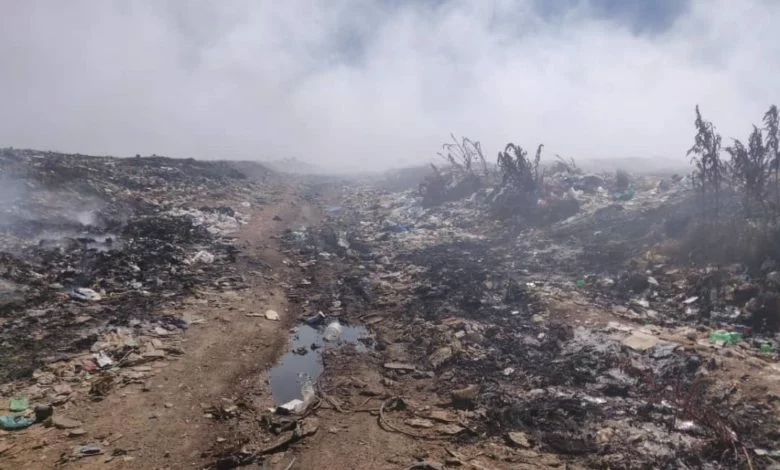
Thick clouds of smoke smouldering from Bulawayo’s Richmond Landfill continue to haunt residents of Cowdray Park and nearby suburbs, turning daily life into a health nightmare.
The waste dumpsite, locally known as Ngozi Mine, is located near the only high school in the area. Residents say that on days when the smoke is particularly intense, both learners and teachers are forced to abandon classes.
Persistent fires at the site emit toxic fumes that drift across residential areas, sparking what locals describe as a full-blown public health crisis. Despite years of complaints and engagements with authorities dating back to 2021, residents say the Bulawayo City Council has failed to provide meaningful solutions.


While council officials tout ambitious waste-to-energy plans, modelled after Harare’s Pomona project and backed by potential international partners, the reality on the ground remains grim. Residents continue to battle thick, choking smoke that has rendered parts of their neighbourhood nearly uninhabitable.
On this topic
According to the latest full council minutes, Bulawayo Mayor Councillor David Coltart emphasised the need to adopt international best practices for transforming the Ngozi Mine site, and highlighted the potential for business partnerships given the profitability of waste management initiatives.
Town Clerk Christopher Dube told the same meeting that the proposed waste-to-energy project has been delayed due to regulatory processes involving the Zimbabwe Investment and Development Agency (ZIDA) and the Procurement Regulatory Authority of Zimbabwe (PRAZ). He also noted that government is planning to engage all local authorities to emulate Harare’s Pomona model, with a ministerial development order in the pipeline to address landfill challenges.
Dube further explained that ZIDA has introduced a policy shift and no longer accepts unsolicited bids, complicating council efforts to innovate. Previous proposals by the council were rejected, with ZIDA instructing the local authority to follow an open tender process instead.
Speaking to CITE, Ward 28 resident representative Nephat Ndlovu said efforts to engage the council have yielded no positive results.
“In August 2021, we wrote a formal letter to the city council. They came here for a meeting the following month, but to this day, we’re still facing the same problem,” he said.
“This smoke finds its way into our homes even with windows closed. At night, we sleep with it lingering inside. We’re seriously worried about our health. Prolonged exposure to this smoke is dangerous.”
Another resident, Michael Bhebhe, urged the council to repair existing machinery at the dumpsite and explore safer alternatives to open burning.
“The council should consider fixing the equipment already lying idle at the landfill. If it worked, perhaps it could help process the garbage instead of burning it,” Bhebhe said.
Carol Phiri, another local resident, said the council’s earlier attempt to cover waste with layers of soil had since been abandoned.
“They tried that method briefly, but then they stopped. We really need a permanent solution. If there are businesspeople interested in recycling here, and if that can help, then we welcome it. We’re tired of this smoke.”
Michael Ndlovu, a representative of the Bulawayo Progressive Residents Association (BPRA), said the health of schoolchildren and teachers is also under threat.
“The nearby school is greatly affected. On days when the smoke is too much, lessons are disrupted. Sometimes the children are sent home early,” he said.
Ward 28 Councillor Ntandoyenkosi Ndlovu confirmed they have asked the city council to consider relocating the landfill to a less populated area, but the proposed move has been deemed too costly.
“We’ve asked the council to move the landfill to the outskirts of the city, where no one lives, but we’ve been told that the process would cost an estimated US$4 million,” he said.
“Even if the Pomona project is replicated here, we need assurance that no burning will take place. Residents have suffered enough. Any business partner involved must prioritise people’s welfare over profit. Ultimately, we need to relocate the site.”
Member of Parliament for Cowdray Park, Arthur Mujeyi, also voiced concern, saying the smoke affects tens of thousands of people.
“I live here too, and I know what residents are going through. Cowdray Park has nearly 75 000 households, and a significant number are affected by this smoke,” he said.
“We’ve had reports of miscarriages and disease outbreaks linked to smoke inhalation. Some schoolchildren are abandoning classes. When the landfill was established, there were no residents nearby, but that has changed, and so must the location of the landfill.”
Mujeyi said he is working with local councillors to pressure the city council into taking action, but progress has been slow.
“We’ve been lobbying the city council on this issue with no meaningful response so far. A parliamentary tour is scheduled for next month, and we hope that during that visit we can highlight the urgency of this matter. If we can replicate an effective project like Pomona here, it could provide much-needed relief.”
At CITE, we dig deep to preserve the stories that shaped us—ZPRA Liberation Archives, the DRC War, and more. These are not just stories—they’re our roots. We don’t hide them behind paywalls. We rely on you to keep them alive. Click here to donate: https://cite.org.zw/support-local-news/





Leave a Reply