
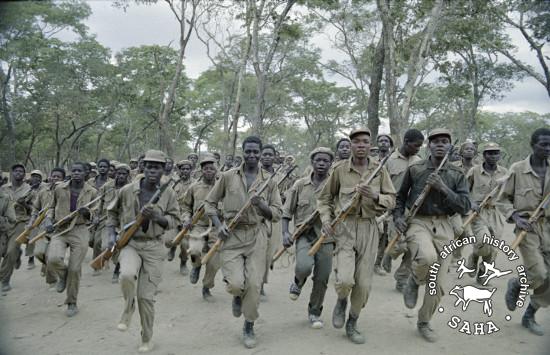
When Zimbabwe celebrated its hard-won independence in 1980, Robert Ndebele had dreams of becoming one of the country’s finest soldiers.
A former ZPRA cadre, he joined the Zimbabwe Military Academy in Gweru, eager to merge his battlefield experience with formal military training.
Graduating with the rank of Captain, Ndebele felt proud. “I thought I had achieved greatness,” he recalled. “We trained as commanders, and after passing, I was given my rank as a captain along with other colleagues.”
But his ambitions soon collided with a harsh political reality. Deployed as an instructor, Ndebele was sent to the Fifth Brigade, a notorious military unit that would soon become a symbol of terror.
On this topic
“I thought I was joining the army,” he said, “But I had joined a ZANU brigade. We were forced to chant party slogans: ‘Pamberi neZANU, Pasi naDumbuguru’ (Forward with ZANU, down with Big-belly). Many of us refused to chant ‘down with Nkomo.’ That refusal marked us as enemies. Perrence Shiri was the commander there.”
Ndebele’s story mirrors the experiences of many ZPRA veterans who faced systematic persecution under the new black government.
Rather than being honoured for their sacrifices, these freedom fighters became victims. Some were dismissed from the national army. Others vanished without a trace.
Many fled the country, escaping the reach of state operatives determined to silence them.
As the euphoria of independence swept across the nation, former ZPRA fighters found themselves under a shadow of suspicion.
Their affiliation with ZAPU made them political outcasts in a country now dominated by ZANU.
Accusations of rebellion and conspiracy surfaced. Many ZPRA veterans were arrested, tortured, and imprisoned without trial.
Patrick Dube, who was a Lieutenant Sergeant, recalls how he ended up quitting the army after a series of arrests while as a serving officer.
“I was arrested many times, accused of operating at night in a white Peugeot to Lupane yet I was based at Four Brigade in Masvingo,” said Dube.
“That constant victimisation. You say you are loyal and working then you get accused of being a dissident at night. It showed me that I was not wanted. I then decided to resign.”
Another ZPRA cadre, Ndodana Nyathi, adds that part of his regret is despite their sacrifices for independence, their role in the war became a source of suffering rather than recognition and empowerment.
Nyathi, born in Tsholotsho joined the struggle in 1977 and operated mainly in Tsholotsho.
He said beyond physical victimisation, ZPRA veterans faced economic and political exclusion where most fighters were sidelined from key positions in the military, government, and state enterprises.
“I regret that we were used. After being used, we were not given anything. I still remember the current President while he was still the Minister of Defence. Japan came and wanted to give us cars, we needed to do a driving course.
“Upon passing it you will then approach a garage, chose a car of your choice, complete the forms then go to your commander to sign for you bring back that form then they do a stop-order and you get your car.
Mnangagwa refused saying there won’t be any difference between a commander and a private. So, they rejected those Japanese cars,” said Nyathi.
The biggest setback that hit ZPRA cadres was the Gukurahundi genocide that targeted mostly Matabeleland and parts of Midlands provinces, during which the Fifth Brigade, a North Korean-trained elite unit, was deployed to crush perceived dissent in Matabeleland and Midlands, areas historically aligned with ZPRA.
The government, led by Robert Mugabe, viewed ZPRA as a threat due to its strong military organisation and Ndebele-dominated support base.
ZPRA veterans were among the primary targets, accused of plotting against the government. Many were arrested, tortured, or executed, while others fled into exile.
Properties and businesses owned by ZPRA-affiliated individuals were confiscated, and some war veterans were forced into destitution. The brutal suppression resulted in thousands of deaths and deepened the divide between former liberation allies.
ZPRA had acquired several properties during the war, meant to support its veterans after independence. However, in the 1980s, the government seized many of these assets, leaving ZPRA veterans economically vulnerable and unable to benefit from the resources they had fought for.
Even during the land reform programme in the early 2000s, ZPRA veterans were largely excluded from resettlement schemes, further entrenching their economic hardship.
The story of ZPRA veterans is one of betrayal and victimisation by the very government they helped bring to power. From political persecution and economic marginalisation to land dispossession and lack of recognition, these ex-combatants have endured decades of hardship.
Their plight highlights the deep-seated divisions and unresolved injustices within Zimbabwe’s post-independence history.
They had marched through the dust of war, shouldered the weight of liberation, and envisioned a free Zimbabwe where their sacrifices would be honoured. But for many of them, independence in 1980 did not bring the peace they had fought for. Instead, it marked the beginning of a different battle, one of persecution, betrayal, and survival.
For years, these veterans lived in the margins of society, stripped of recognition, denied opportunities, and haunted by the war they had fought for a country that abandoned them.
Yet, despite decades of silence and suffering, their resilience remains unbroken. Today, they continue to demand justice, recognition, and a rightful place in Zimbabwe’s history, a history they bled to write.




Leave a Reply