
By Irvine Sibhona aka Barbetone Muzwambira
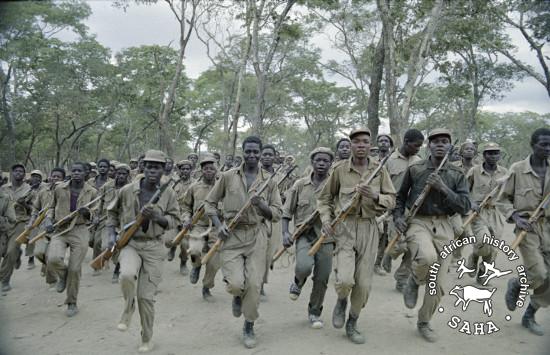
In the first issue, we explained that it was important for ZAPU to establish a regular army to manage the burgeoning number of forces which resulted from ZPRA’s effective recruitment machinery.
Furthermore, ZAPU was now thinking beyond the war and preparing to run the state. To this end, it was important to establish a regular army to minimise dependence on the Rhodesian establishment at independence (which sadly became the case, because of ZANU-PF’s lack of similar foresight). Importantly also, there was parallel training in a number of civilian sectors, which would enable the revolutionary party to hit the ground running in terms of running a functional state.
However, the deployment of the regular force was easy only on paper, in reality, it was complicated by a number of unseen factors. The first serious challenge was the death of senior leaders of the revolution, among which the death of ZPRA commander and military genius Alfred Nikita Mangena was indescribably difficult to take.
On this topic
Because of his brilliant leadership qualities and exceptional military skills particularly in guerrilla warfare, he rose quickly through the ranks to become the second ZPRA commander. An exceptional strategist and even better organiser who was also renowned for his discipline, under his leadership ZPRA became a smooth, feared machine. His links in the two most important countries to the armed struggle – Zambia and Mozambique – also made it easier for ZPRA units to penetrate Rhodesia almost effortlessly. His loss therefore rocked not just ZPRA but the whole African liberation movement to the core.
One of the most crucial factors was the ZPRA leadership’s decision, taken just prior to the deployment of the regular force, to take the war to the Rhodesians. Before, guerilla warfare was mainly defensive, with operations limited to defending positions or picking targets where the strategic interests of ZPRA or the liberation struggle in general were threatened or at stake. After this decision, ZPRA had to be on the offensive, the end desire being to push the Rhodesian Front into the defensive in order to force them to spread their resources.
This decision took the war into a different direction and directly resulted in the controversial downing of two Rhodesian civilian planes, one of which had been thought to be transporting Rhodesian Front military targets, including their dreaded commander, Peter Walls. These two incidents or the infamous downing of the Viscounts as they are historically known – and other serious incursions by ZPRA infuriated the Rhodesian government. From this point, ZPRA forces turned into public enemy number one for the Rhodesian Front and its regional and international supporters. The narrative of ZPRA and ZAPU as dreaded blended terrorists rather than freedom fighters solidified among this alliance of retrogressive forces.
However, as hinted in the first instalment, the deployment of the regular army commenced undeterred by developments that would have stopped a less determined force. It was commanded by yours truly, Barbetone Muzwambira, a product of the officer’s training programme at Zambia Military Academy (ZMA), Kabwe. Other senior officers in this battalion were Sambulo, Richard Moyo, and Musonda. They were all products of the ZMA. After completing its initial tasks, this Battalion was posted to the Southern Front, which stretched from Plumtree to Mutare, south of the railway line.
The second battalion was sent to the Northern Front, which encompassed the Tsholotsho area, under the command of Smile Madubeko (aka Moyo). This battalion was armed to the teeth with all support arms, including anti-air guns, double barrels and the Sam 7 missile popularly known as the Strela to cover them.
The third battalion was deployed at the Kariba Basin, commanded by Maj-General Stanford Khumalo, whose nom de guerre was Madliwa. This was the battalion that also made history after it was accidentally discovered by the Rhodesian Air Force.
The Rhodesian Special Forces (RSF) thought they had discovered a small base of a ZPRA company of guerillas, which they could dispel quickly. However, what was supposed to be a minor operation turned into one of the major battles of the entire war, which raged on for a full seven days, until the commander of the Rhodesian army ordered his forces to retreat. This battle is still celebrated in ZPRA and liberation folklore as an example of the tenacity of African liberation forces, a true tribute to struggle luminaries like Nikita Mangena.
In March 1979, the Special Branch received intelligence which led to a rather fortuitous discovery of ZPRA’s plans for a regular force, albeit sketchy. RSF intelligence in Botswana received critical information that ZPRA vehicles purchased in South Africa were being transited through Botswana to Zambia. The information also indicated that two high-ranking ZIPRA officers would be transiting – Dumiso Dabengwa the ‘Black Russian’ and Elliot Sibanda, aka Black Swine Mnyamana. On 29 March 1979, Selous Scouts dressed as ZPRA combatants laid an ambush along the highway in Northern Botswana.
When the convoy approached the ‘kill zone’ the Scouts were unsure who would be in which of the several vehicles. A short contact deactivated some of the cars, and Black Swine was critically injured. A bullet had ripped his stomach open. The Black Russian was not found among the casualties and was assumed to have escaped. Black
Black Swine was taken across the border to Rhodesia. He was flown to Salisbury and offered medical attention in exchange for vital Intel on ZPRA operations and plans. According to legend, the special branch then interviewed Black Swine in the hospital while dangling the threat that they would remove the lifesaving apparatus, such as oxygen masks and drips and let him die. He apparently began singing to save his life.
Rhodesia therefore became aware that ZPRA had received support for conventional warfare from the USSR. They also became aware of Cuban instructors training ZPRA forces in conventional warfare for a potential invasion code-named ‘Operation ZERO Hour’. However, the specifics of the invasion plans remained unclear. The Special Branch and CIO were unable to uncover detailed information, but the capture of Black Swine helped fill in the intelligence gap.
It became a life and death situation when the RSF also learnt that ZPRA had tanks and armoured cars, ready to invade Rhodesian borders. They also learnt about plans for an air force ZPRA was preparing, with pilot training already in progress.
It was this information that put so much pressure on the Rhodesia government to truly end the war before they ran out of the country on defeat such as the Vietnam War.





Leave a Reply